Predicting Marital Forgiveness after Infidelity Using Explainable Artificial Intelligence and Relational Trauma Indicators
Keywords:
Marital Forgiveness, Infidelity, Explainable Artificial Intelligence, Machine Learning, Relational Trauma, Dyadic Trust, Attachment Insecurity, Psychological Distress, Relationship Quality, XGBoostAbstract
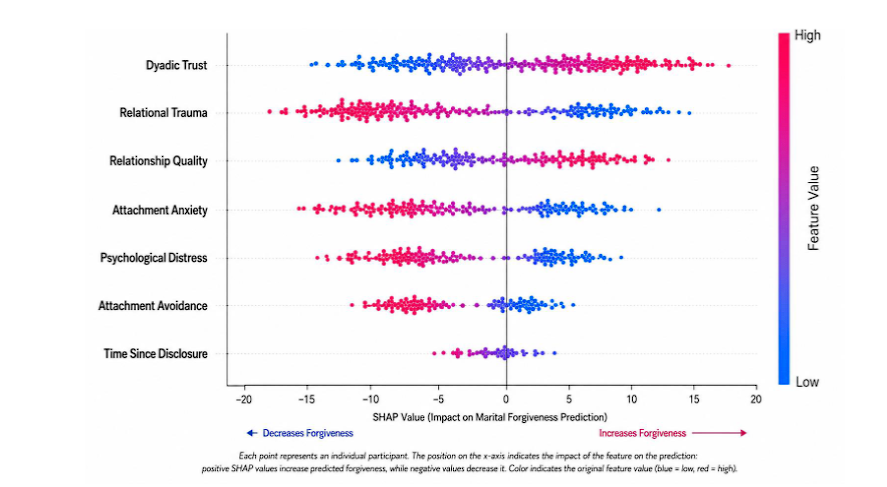
The present study aimed to predict marital forgiveness following infidelity using explainable artificial intelligence models and relational trauma indicators while identifying the relative importance of trust, attachment insecurity, psychological distress, and relationship quality in determining forgiveness outcomes among married individuals affected by extramarital relationships. This cross-sectional predictive study was conducted among 548 married individuals in Turkey who had experienced emotional, sexual, or combined forms of partner infidelity and remained in their relationships following disclosure. Participants were recruited from counseling centers, family therapy clinics, and online support networks. Data were collected using standardized measures of marital forgiveness, relational trauma, attachment insecurity, psychological distress, dyadic trust, and relationship quality. Several machine learning algorithms, including Elastic Net Regression, Support Vector Regression, Random Forest Regression, LightGBM, and Extreme Gradient Boosting (XGBoost), were developed and evaluated. Model performance was assessed using the coefficient of determination (R²), root mean square error (RMSE), mean absolute error (MAE), and mean absolute percentage error (MAPE). Explainable Artificial Intelligence techniques based on Shapley Additive Explanations (SHAP) were employed to identify and interpret the relative contribution of each predictor variable to forgiveness outcomes. Correlation analyses indicated that marital forgiveness was significantly and negatively associated with relational trauma, attachment anxiety, attachment avoidance, and psychological distress, while showing significant positive relationships with dyadic trust and relationship quality (p < .01). Among the evaluated machine learning algorithms, the XGBoost model demonstrated the highest predictive performance, explaining 84% of the variance in marital forgiveness (R² = .84), followed by LightGBM (R² = .81) and Random Forest Regression (R² = .78). SHAP analyses revealed that dyadic trust was the strongest predictor of forgiveness, followed by relational trauma, relationship quality, attachment anxiety, psychological distress, attachment avoidance, and time since disclosure. Cross-validation analyses confirmed the stability and robustness of the final model, with R² values consistently ranging between .83 and .85 across validation folds. The findings demonstrate that marital forgiveness following infidelity can be accurately predicted through explainable artificial intelligence models that integrate relational trauma indicators and psychological relationship variables. Trust restoration and trauma recovery emerged as the most influential determinants of forgiveness, highlighting the importance of trauma-informed and attachment-focused interventions in couples recovering from betrayal. The application of explainable artificial intelligence not only improved predictive accuracy but also enhanced understanding of the mechanisms underlying forgiveness after infidelity, offering valuable implications for assessment, treatment planning, and the development of personalized therapeutic approaches for distressed couples.
Downloads
References
Alexander. (2022). 52-Year-Old Man • Erectile Dysfunction • Insomnia • Migraine Headaches • Disclosure of Infidelity. 71(6). https://doi.org/10.12788/jfp.0438
Cornelius‐White, J. H. D., & Kanamori, Y. (2025). The Correlates and Effectiveness of Partner-Focused Prayer: A Meta-Analysis of Relational Health. Psychology of Religion and Spirituality, 17(2), 71-81. https://doi.org/10.1037/rel0000508
Curtis, R., Likis‐Werle, E., & Shelton, T. L. (2021). Counseling Clients Who Have Experienced Undisclosed Infidelity. The Family Journal, 29(4), 457-464. https://doi.org/10.1177/10664807211005066
Dacka, M., Kulik, A., & Nowak, K. (2023). Determinants of Forgiveness After Experiencing Infidelity in a Marital Relationship. Kwartalnik Naukowy Fides et Ratio, 54(2), 44-57. https://doi.org/10.34766/fetr.v54i2.1185
Davidar, R. S., Ballal, D., & Rajan, S. K. (2025). Treatment of Attachment Trauma: Effects of an Online EMDR Couple Protocol on Trauma Symptoms, Conflict Resolution, and Forgiveness. Counselling and Psychotherapy Research, 25(3). https://doi.org/10.1002/capr.70042
Fife, S. T., Gossner, J., Theobald, A. C., Allen, E., Rivero, A., & Koehl, H. (2023). Couple Healing From Infidelity: A Grounded Theory Study. Journal of Social and Personal Relationships, 40(12), 3882-3905. https://doi.org/10.1177/02654075231177874
Giacobbi, M., & Lalot, F. (2025). Unpacking Trust Repair in Couples: A Systematic Literature Review. Journal of Family Therapy, 47(1). https://doi.org/10.1111/1467-6427.12483
Hajihasani, M. (2026). Retaliatory Marital Infidelity After Betrayal. European Journal of Psychology Open, 85(1), 29-37. https://doi.org/10.1024/2673-8627/a000089
Hamedani, K. H., Majzoobi, M. R., & Forstmeier, S. (2024). The Relationship Between Perfectionism and Marital Outcomes: A Systematic Review and Meta-Analysis. Frontiers in psychology, 15. https://doi.org/10.3389/fpsyg.2024.1456902
Irvine, T. J., & Peluso, P. R. (2021). An Affair to Remember: A Mixed-Methods Survey Examining Therapists’ Experiences Treating Infidelity. The Family Journal, 30(3), 324-333. https://doi.org/10.1177/10664807211061826
Jules, B. N., O’Connor, V., & Langhinrichsen‐Rohling, J. (2023). Judgments of Event Centrality as Predictors of Post-Traumatic Growth and Post-Traumatic Stress After Infidelity: The Moderating Effect of Relationship Form. Trauma Care, 3(4), 237-250. https://doi.org/10.3390/traumacare3040021
Karadzhy, O. (2023). Coping Behaviour of Women in the Situation When Their Partner Cheated. Scientific Bulletin of Mukachevo State University Series “Pedagogy and Psychology”, 9(4), 18-26. https://doi.org/10.52534/msu-pp4.2023.18
Kasprzak, A. (2025). Forgiveness in Romantic Relationships: The Moderating Role of Differentiation of Self in the Relationship Between Offense Severity and Post‐Offense Distress. Family Process, 64(4). https://doi.org/10.1111/famp.70082
Kılınçer, H. (2023). Family Counseling With the Spiritually-Directed Satir Model: A Case Report. Spiritual Psychology and Counseling, 8(2), 109-131. https://doi.org/10.37898/spc.2023.8.2.188
Mahoney, A., Chinn, J. R., & McGraw, J. S. (2022). Positive Psychology and Religiousness/Spirituality in the Context of Couples and Families. 445-459. https://doi.org/10.1007/978-3-031-10274-5_28
Mairal, J. B., & Polanski, T. (2021). Infidelity Treatment From an Integrative Behavioral Couple Therapy Perspective: Explanatory Model and Intervention Strategies. Journal of marital and family therapy, 47(4), 909-924. https://doi.org/10.1111/jmft.12483
Najibzadegan, A., Bahrainian, S. A., & Shahabizadeh, F. (2024). Efficacy of Acceptance and Commitment Therapy on Intimacy, Marital Forgiveness, and Marital Burnout in Women Affected by Extramarital Relationships. Aftj, 5(3), 102-112. https://doi.org/10.61838/kman.aftj.5.3.11
Ngwasheng, M. B., & Mbedzi, R. P. (2024). Infidelity Amongst Young Married Couples: Suggestions for Social Work Intervention. Social Work/Maatskaplike Werk, 60(1). https://doi.org/10.15270/60-1-1255
Ripley, J. S., Worthington, E. L., Kent, V. M., Loewer, E., & Chen, Z. J. (2022). Spiritually Incorporating Couple Therapy in Practice: Christian-Accommodated Couple Therapy as an Illustration. Psychotherapy, 59(3), 382-391. https://doi.org/10.1037/pst0000411
Rokach, A., & Chan, S. H. (2023). Love and Infidelity: Causes and Consequences. International journal of environmental research and public health, 20(5), 3904. https://doi.org/10.3390/ijerph20053904
Şahan, B. (2021). Does Forgiveness Affect Marital Satisfaction? Spiritual Psychology and Counseling, 83-108. https://doi.org/10.37898/spc.2021.6.3.146
Salehi, M., Abkenar, B. N., & Sarajari, M. Y. (2023). Effectiveness of Integrated Couples Therapy on Intimacy and Marital Forgiveness Among Women Affected by Extramarital Relationships. PWJ, 4(3), 69-76. https://doi.org/10.61838/kman.pwj.4.3.9
Shrestha, P. S., Shaver, S. R., Perlman, T. T., & Walsham, W. (2023). Emotional Dimensions of Infidelity: An Analysis of Psychological and Emotional Factors Affecting Relationship Infidelity. Jurnal Sosial Sains Terapan Dan Riset (Sosateris), 11(2), 88-103. https://doi.org/10.35335/85rbw180
Sobhani, F. F., Shiroudi, S. G., & Khodabakhshi‐Koolaee, A. (2021). Effect of Two Couple Therapies, Acceptance and Commitment Therapy and Schema Therapy, on Forgiveness and Fear of Intimacy in Conflicting Couples. Practice in Clinical Psychology, 9(4), 271-282. https://doi.org/10.32598/jpcp.9.4.746.3
Suhailah, F., & Afiatin, T. (2020). The Dynamics of Family Psychological Strength in Wives Whose Husbands Have Affairs. https://doi.org/10.2991/assehr.k.200728.038
Tauy, J. J. M., & Perez, J. (2023). Mediating Role of Infidelity-Related Posttraumatic Symptoms in the Relationship Between Forgiveness and Psychological Health Concerns. Psikoislamika Jurnal Psikologi Dan Psikologi Islam, 20(2), 579-598. https://doi.org/10.18860/psikoislamika.v20i2.23871
Tittler, M. V., & Wade, N. G. (2022). Gender, Group Composition, and Outcomes of Group Interventions to Promote Forgiveness: Replication and Extension. Group Dynamics Theory Research and Practice, 26(2), 119-136. https://doi.org/10.1037/gdn0000154
Torani, R. A., & Fard, M. S. (2024). Efficacy of Emotion-Focused Couple Therapy on Intimacy, Marital Adjustment, and Forgiveness Among Couples With a History of Extramarital Affairs. Aftj, 5(2), 95-102. https://doi.org/10.61838/kman.aftj.5.2.11
Uwen, G. s. O., Ekpenyong, B., Onah, G. A., & Akpanika, E. N. (2023). Emotional Women and Promiscuous Men: Language Use as Discursive Stances of Wives on Cheating Husbands. Environment and Social Psychology, 8(3). https://doi.org/10.54517/esp.v8i3.1848
Walravens, G., & Rober, P. (2023). Relational Recovery After Infidelity as a Dual Process: A Model Based on the Experiences of Female Injured Partners. Family Process, 63(1), 151-162. https://doi.org/10.1111/famp.12857
Yousefi, S., Bafghi, Z. R., Ahmadi, A., Joulaei, H., Bolhari, J., & Mirzai, M. (2023). Spirituality Enhanced With Cognitive-Behavioral Techniques in Extramarital Infidelity: A Literature Review. Zahedan Journal of Research in Medical Sciences, 26(2). https://doi.org/10.5812/zjrms-135837

Downloads
Published
Submitted
Revised
Accepted
Issue
Section
License
Copyright (c) 2026 Meral Barlık ; Sevde Kocabas (Author)

This work is licensed under a Creative Commons Attribution-NonCommercial 4.0 International License.