The Structural Relationships among Differentiation of Self, Conflict Resolution Styles, Emotional Intimacy, and Marital Stability
Keywords:
Differentiation of Self, Conflict Resolution Styles, Emotional Intimacy, Marital Stability, Structural Equation ModelingAbstract
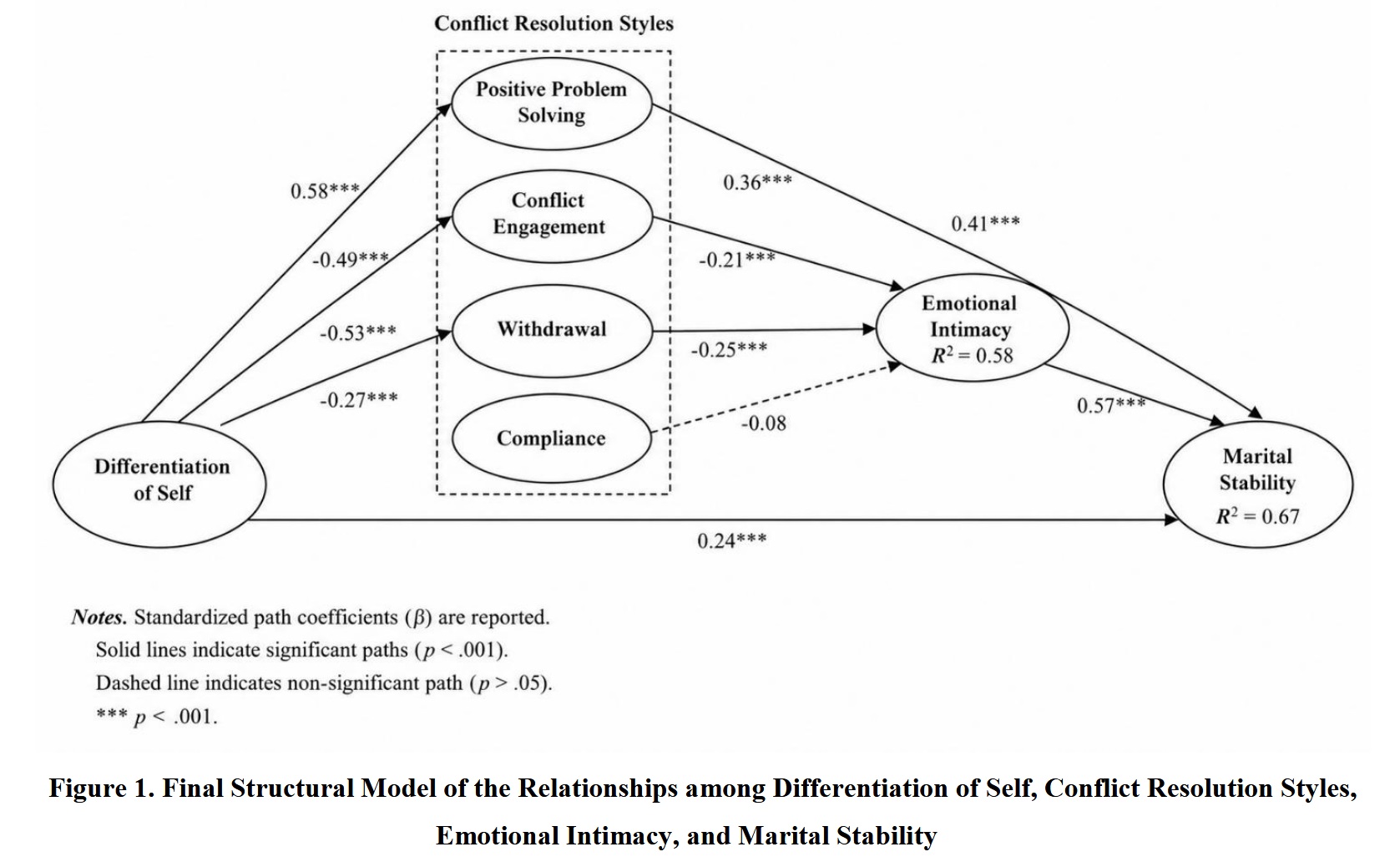
The present study aimed to examine the structural relationships among differentiation of self, conflict resolution styles, emotional intimacy, and marital stability and to investigate the direct and indirect pathways through which these variables influence marital stability among married adults. This study employed a cross-sectional correlational design using structural equation modeling (SEM). The participants consisted of 642 married adults residing in the United States who were selected through online and community-based recruitment methods. Data were collected using the Differentiation of Self Inventory-Revised (DSI-R), the Conflict Resolution Styles Inventory (CRSI), the Emotional Intimacy Scale (EIS), and the Marital Instability Index (MII). Descriptive statistics, Pearson correlation analyses, confirmatory factor analysis, and structural equation modeling were conducted using SPSS 29 and AMOS 29. Model fit was evaluated using multiple goodness-of-fit indices, and indirect effects were tested through bootstrapping procedures with 5,000 resamples. The proposed structural model demonstrated satisfactory fit to the data (χ²/df = 2.57, CFI = 0.948, TLI = 0.942, GFI = 0.918, AGFI = 0.904, RMSEA = 0.050, SRMR = 0.047). Differentiation of self positively predicted positive problem-solving conflict resolution (β = 0.58, p < .001), emotional intimacy (β = 0.41, p < .001), and marital stability (β = 0.24, p < .001), while negatively predicting conflict engagement (β = -0.49, p < .001) and withdrawal (β = -0.53, p < .001). Positive problem solving positively predicted emotional intimacy (β = 0.36, p < .001), whereas conflict engagement (β = -0.21, p < .001) and withdrawal (β = -0.25, p < .001) negatively predicted emotional intimacy. Emotional intimacy emerged as the strongest predictor of marital stability (β = 0.57, p < .001). Significant indirect effects were observed between differentiation of self and marital stability through conflict resolution styles and emotional intimacy (β = 0.33, p < .001). The model explained 58% of the variance in emotional intimacy and 67% of the variance in marital stability. The findings indicate that differentiation of self contributes significantly to marital stability both directly and indirectly through constructive conflict resolution styles and enhanced emotional intimacy. Emotional intimacy functions as a central mechanism linking individual psychological functioning and interpersonal relationship processes to marital stability. Interventions designed to strengthen self-differentiation, improve conflict management skills, and foster emotional intimacy may be effective strategies for promoting stable and satisfying marital relationships.
Downloads
References
Adibkia, A., Emamipour, S., Arshadi, F. K., & Mohammadkhani, P. (2022). The Relationship Between Irrational Beliefs and the Marital Satisfaction Based on the Mediating Role of the Conflict Resolution Behavior and the Marital Stress. Practice in Clinical Psychology, 10(3), 225-232. https://doi.org/10.32598/jpcp.10.3.779.1
Afshin, A., Ganji, F., & Yaghobiyan, R. (2024). Predicting Marital Intimacy Based on Attachment Styles, Early Maladaptive Schemas, and Love Styles in Married Female Students. Aftj, 5(1), 108-114. https://doi.org/10.61838/kman.aftj.5.1.12
Ashraf, R., Syed, U. E., Khan, A., & Bibi, N. (2024). The Moderating Role of Marital Adjustment in Relationship Between Perceived Maternal Parenting Styles and Family Functioning Among Fathers. Canadian Journal of Family and Youth / Le Journal Canadien De Famille Et De La Jeunesse, 16(2), 91-111. https://doi.org/10.29173/cjfy30003
Bakhshi, S., & Sadeghi, M. (2023). Developing a Model of Marital Adjustment Based on Self-Compassion, Marital Intimacy and Job Satisfaction in Married Female Teachers. PWJ, 4(1), 107-116. https://doi.org/10.61838/kman.pwj.4.1.12
Castillo‐López, Á. G. d., Berenguer-Soler, M., Pineda, D., & José, A. G. d. C. (2024). Emotional Flooding in Couple Relationships: Psychosocial Aspects and Regulatory Strategies. https://doi.org/10.5772/intechopen.1006183
Dehghanidowlatabadi, S., Pallathadka, H., Ismail, S. M., Abdullaev, D., Ibrahim, F. M., & Prasad, K. D. V. (2025). Moderating Effect of Interpersonal Mindfulness Between Marital Conflict and Marital Intimacy Among Iranian Married Individuals. Brain and Behavior, 15(3). https://doi.org/10.1002/brb3.70392
Dehno, H. E. (2023). Predicting Emotional Divorce Based on Self-Differentiation and Marital Expectations in Women. PWJ, 4(4), 9-16. https://doi.org/10.61838/kman.pwj.4.4.2
Farooq, Z., Akhtar, N., & Zacchilli, T. L. (2024). Validation of Romantic Partner Conflict Scale (RPCS) in Pakistani Married Couples: Establishing Measurement Invariance. Interpersona an International Journal on Personal Relationships, 18(1), 79-103. https://doi.org/10.5964/ijpr.12555
Gacinya, D. J. (2024). Determinants of Divorce in Rwanda: A Case Study of Kigali City. strategicjournals.com, 11(1). https://doi.org/10.61426/sjbcm.v11i1.2838
Ghasemi, Y. (2023). The Relationship Between Attachment Symbols, Attachment Styles and Self-Differentiation With Marital Intimacy. Obstetrics Gynecology and Reproductive Sciences, 7(4), 01-08. https://doi.org/10.31579/2578-8965/168
Gyasi, W. K. (2023). Humor as an Ice Breaker in Marital Tension: A Family Communication Perspective. Mediterranean Journal of Social & Behavioral Research, 7(2), 103-111. https://doi.org/10.30935/mjosbr/13076
Hashemi, S., Behboodi, M., & Fard, F. D. (2023). Comparison of the Effectiveness of the Premarital Awareness and Interpersonal Choices Program (PICK) and the SYMBIS Premarital Model on Girls' Attitudes Toward Marriage. Jarac, 5(4), 154-163. https://doi.org/10.61838/kman.jarac.5.4.17
Hosseinpoor, M., Masoumi, S. Z., Kazemi, F., Soltani, F., & Ahmadpanah, M. (2022). Investigating the Effect of Couple-Centered Counseling by Gottman Method on the Intimacy of Infertile Couples Referring to the Infertility Ward of Fatemieh Hospital, Hamadan, Iran in 2020: A Quasi-Experimental Study. BMC psychiatry, 22(1). https://doi.org/10.1186/s12888-022-04228-z
Ibrahim, M., Palit, M., & Matthews, R. (2023). Intergenerational Attachment Styles, Emotional Regulation and Relational Outcomes in Couples Therapy. https://doi.org/10.5772/intechopen.108492
K., S., & S., I. (2024). Social and Cultural Implications of Live-in Relationships in India. International Journal for Multidisciplinary Research, 6(3). https://doi.org/10.36948/ijfmr.2024.v06i03.20396
Kondari, F. M., Zarrin, S. A., & Yousefi, A. A. (2023). Comparison of Marital Conflict Model Based on Selfdifferentiation and Familism With the Mediating Role of Intimacy and Emotional Maturity in Traditional and Modern Families. Jayps, 4(3), 20-34. https://doi.org/10.61838/kman.jayps.4.3.3
Kordovani, S., Pour, S. K., & Nejad, F. S. T. (2024). Comparison of the Effectiveness of Integrated Behavioral Couple Therapy and Schema-Focused Couple Therapy on Conflict Resolution Styles in Conflicting Couples. Aftj, 5(2), 68-78. https://doi.org/10.61838/kman.aftj.5.2.8
Li, Y., Aggarwal, P., & Lawrence, E. (2025). Cultural Adaptation of the Relationship Quality Interview (RQI) for Mandarin-Speaking Chinese Couples: A Pilot Study. https://doi.org/10.21203/rs.3.rs-6590877/v1
Mardani, F., Navabinejad, S., & Yousefi, E. (2024). Identifying Factors and Contexts Leading Couples to Mutual Divorce. Aftj, 5(1), 78-88. https://doi.org/10.61838/kman.aftj.5.1.9
Mardani, M., Marashi, S. A., & Abbaspour, Z. (2021). On the Causal Relationship Between Attachment Styles and Marital Satisfaction: Mediating Role of Gottman's Marital Communication Model. Iranian journal of psychiatry and behavioral sciences, 15(2). https://doi.org/10.5812/ijpbs.108339
Muturi, E. (2023). The Impact of Boredom in Marriage on Marital Satisfaction. International journal of psychology, 8(3), 43-54. https://doi.org/10.47604/ijp.2120
Namazi, S. A., & Kermani, M. (2023). Predicting the Inclination to Extramarital Relations Based on Sexual Assertiveness and Spouse Selection Criteria in Married Women. PWJ, 4(2), 24-31. https://doi.org/10.61838/kman.pwj.4.2.4
Nazemi, M., Majd, M. A., Ghamari, M., & Asadi, M. (2023). Qualitative Comparison of Satisfactory Stable Marriages and Marriages With Dissatisfaction in Infertile Couples. Jayps, 4(7), 1-13. https://doi.org/10.61838/kman.jayps.4.7.1
Obioma, I. F., Raina, M., Jaga, A., Asekun, W. A., Misurya, P., & Bark, A. S. H. (2025). Gender and Marital Burnout Within Four Countries: Examining the Effects of Conflict Negotiation Styles. Journal of Social and Personal Relationships, 42(12), 3509-3533. https://doi.org/10.1177/02654075251371383
Okonkwo, K. (2024). The Role of Attachment Styles in Marital Stability: A Psychological Approach to Strengthening Relationships. American Journal of Psychology, 6(4), 35-50. https://doi.org/10.47672/ajp.2474
Radpour, B., Behboodi, M., & Fard, F. D. (2023). The Effectiveness of Preventation and Relationship Enrichment Program (PREP) on Marital Conflicts and Sexual Satisfaction in Couples. Jarac, 5(3), 127-135. https://doi.org/10.61838/kman.jarac.5.3.17
Sadeghian, E., Ghasemi, S., & Maddineshat, M. (2025). Exploring Marriage Beliefs From the Perspectives of Married Students. Frontiers in psychology, 16. https://doi.org/10.3389/fpsyg.2025.1481905
Safavi, S. R., Hosseini, S. M., Mohammadkhani, P., & Sabahi, P. (2022). Impact of Object Relations Couple Therapy on Marital Intimacy of Divorce Applicant Couples With High-leveL Borderline Personality Organization: A Pilot Study Considering the Moderating Role of Executive Functions. Practice in Clinical Psychology, 10(2), 141-152. https://doi.org/10.32598/jpcp.10.2.799.1
Salehi, M., Abkenar, B. N., & Rashidi, T. (2024). The Effectiveness of Gottman's Systemic Cognitive Couple Therapy on Marital Conflicts, Communication Patterns, and Alexithymia in Couples With Marital Conflict. Jarac, 6(3), 145-152. https://doi.org/10.61838/kman.jarac.6.3.16
Tadros, E., Gomez, E., & Dudek, M. (2022). Couple Connectedness in the Time of COVID-19. The Family Journal, 30(4), 589-595. https://doi.org/10.1177/10664807221082397
Tolla, T. T. (2021). Marital Conflict and Destructive Resolution Tactics: The Case of Bahir Dar City, Ethiopia. Journal of Applied Social Science, 16(1), 160-175. https://doi.org/10.1177/19367244211015134
Wendołowska, A., Czyżowska, N., & Czyżowska, D. (2022). The Role of Attachment and Dyadic Coping in Shaping Relational Intimacy: Actor–Partner Interdependence Model. International journal of environmental research and public health, 19(23), 16211. https://doi.org/10.3390/ijerph192316211
Yousefpouri, M., Zomorodi, S., & Bazzāziān, S. (2024). Effectiveness of Acceptance and Commitment-Based Couples Therapy on Attitudes Towards Marital Infidelity and Emotional Regulation in Married Women. Aftj, 5(2), 103-111. https://doi.org/10.61838/kman.aftj.5.2.12
Zahrakar, K., Nouri, F. L., & Mohsenzadeh, F. (2022). Exploring Factors Affecting Conflict Between Daughter-in-Law and Mother-in-Law: A Qualitative Study. International journal of health sciences, 48338-48365. https://doi.org/10.53730/ijhs.v6ns7.13521

Downloads
Published
Submitted
Revised
Accepted
Issue
Section
License
Copyright (c) 2026 Mireille Claustres ; Gugu Rutherford, Sierra Grant-Ashbaugh (Author)

This work is licensed under a Creative Commons Attribution-NonCommercial 4.0 International License.