The Effectiveness of Narrative Couple Therapy on Relational Identity Reconstruction, Marital Meaning-Making, and Post-Conflict Reconciliation
Keywords:
Narrative Couple Therapy, Relational Identity Reconstruction, Marital Meaning-Making, Post-Conflict Reconciliation, Couple Counseling, Marital Relationships, Narrative Therapy, Relationship AdjustmentAbstract
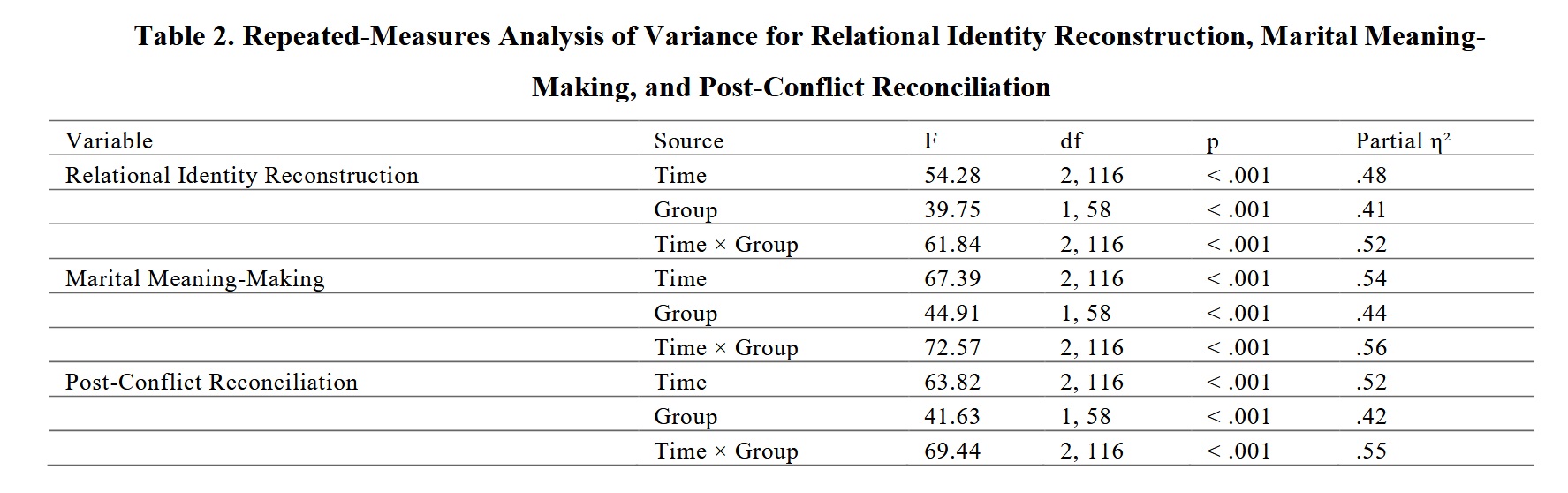
The present study aimed to investigate the effectiveness of Narrative Couple Therapy on relational identity reconstruction, marital meaning-making, and post-conflict reconciliation among married couples experiencing relationship distress in Canada. This study employed a quasi-experimental design with pretest, posttest, and three-month follow-up assessments using a control group. The statistical population consisted of married couples who sought services from counseling centers and family therapy clinics in Canada during 2025. Following eligibility screening, 60 couples (120 individuals) were selected and randomly assigned to an experimental group (30 couples) and a control group (30 couples). The experimental group participated in a 12-session Narrative Couple Therapy program conducted weekly, while the control group received no intervention during the study period. Data were collected using the Relational Identity Reconstruction Scale, the Marital Meaning-Making Questionnaire, and the Post-Conflict Reconciliation Inventory. Data were analyzed using repeated-measures analysis of variance and Bonferroni post hoc comparisons in SPSS version 29. The results revealed significant time, group, and time-by-group interaction effects for all study variables. For relational identity reconstruction, a significant interaction effect was observed, F(2,116) = 61.84, p < .001, η² = .52. Marital meaning-making also demonstrated a significant interaction effect, F(2,116) = 72.57, p < .001, η² = .56. Similarly, post-conflict reconciliation showed a significant interaction effect, F(2,116) = 69.44, p < .001, η² = .55. Bonferroni pairwise comparisons indicated significant improvements from pretest to posttest and from pretest to follow-up across all outcome variables (p < .001). No significant differences were found between posttest and follow-up scores, indicating that treatment gains were maintained over time. The findings indicate that Narrative Couple Therapy is an effective intervention for enhancing relational identity reconstruction, strengthening marital meaning-making, and improving post-conflict reconciliation among married couples. By facilitating the reconstruction of relational narratives and promoting collaborative meaning-making processes, this therapeutic approach contributes to enduring improvements in relationship functioning and emotional connection. The stability of treatment effects at follow-up further supports the utility of Narrative Couple Therapy as a sustainable and evidence-based intervention for couples experiencing relational difficulties.
Downloads
References
Asfaw, L. S., & Alene, G. D. (2023). Effectiveness of a Marital Relationship Skills Training Intervention on Marital Adjustment Among Individuals in Hosanna Town, Southwest Ethiopia: A Randomized‐controlled Trial. Journal of marital and family therapy, 49(3), 541-560. https://doi.org/10.1111/jmft.12641
Barboza, J., Seedall, R. B., Hooghe, A., Kaplow, J. B., & Bradshaw, S. D. (2024). Forming Our Grief Rhythm: The Relational Window of Tolerance for Bereaved Parents. Family Process, 64(1). https://doi.org/10.1111/famp.13048
Corner, G. W., Rasmussen, H. F., Khaled, M., Morris, A. R., Khoddam, H., Barbee, N., Herzig, S. E., Brasby, Y., Seibert, E., Sellery, P., Margolin, G., & Saxbe, D. (2023). The Birth of a Story: Childbirth Experiences, Meaning-Making, and Postpartum Adjustment. Journal of Family Psychology, 37(5), 667-679. https://doi.org/10.1037/fam0001062
Fenske, S. R., Harris, S. M., LaPlant‐Braughton, J., Allen, S. M., Roberts, K. M., & Anderson, G. (2024). It Got Me Thinking: The Impact of Participating in a Divorce Decision‐making Interview. Journal of marital and family therapy, 50(4), 867-881. https://doi.org/10.1111/jmft.12735
Figueiredo, M. H., Pinto, L. R., Leal, F., & Ferreira, M. M. P. (2024). The Transformative Change Towards the Reunion of the Marital Model - Clinical Case Study. International Journal of Health Science, 4(13), 2-9. https://doi.org/10.22533/at.ed.15941324260110
Galovan, A. M., Orbuch, T. L., Shrout, M. R., Drebit, E., & Rice, T. M. (2022). Taking Stock of the Longitudinal Study of Romantic Couple Relationships: The Last 20 years. Personal Relationships, 30(1), 174-216. https://doi.org/10.1111/pere.12452
Hasdenteufel, M., & Quintard, B. (2022). Dyadic Experiences and Psychosocial Management of Couples Facing Advanced Cancer: A Systematic Review of the Literature. Frontiers in psychology, 13. https://doi.org/10.3389/fpsyg.2022.827947
Ibrahim, M., Palit, M., & Matthews, R. (2023). Intergenerational Attachment Styles, Emotional Regulation and Relational Outcomes in Couples Therapy. https://doi.org/10.5772/intechopen.108492
Majzoobi, M. R., & Forstmeier, S. (2022). The Relationship Between the Reminiscence of relationship‐defining Memories and Marital Outcomes: A Systematic Review and meta‐analysis. Journal of Family Theory & Review, 14(1), 7-27. https://doi.org/10.1111/jftr.12442
McHale, J. P., & Jenkins, K. L. (2023). Thinking Three, Revisited: Infants, Coparents, Gender Roles, and Cultural Contexts. Australian and New Zealand Journal of Family Therapy, 44(4), 495-510. https://doi.org/10.1002/anzf.1566
Monk, J. K., Kanter, J. B., & Ogan, M. A. (2021). Prior On–Off Relationship Instability and Distress in the Separation and Divorce Transition. Family Process, 61(1), 246-258. https://doi.org/10.1111/famp.12653
Monk, J. K., Ogolsky, B. G., & Proulx, C. M. (2025). Clarifying Relationship Instability: Exploring the Vital Role of Change in Commitment. Journal of Family Theory & Review, 17(3), 527-548. https://doi.org/10.1111/jftr.12618
Nguyen, P. (2023). Investigating Assortative Mating Patterns by Expanding Personality Assessments Beyond Static and Universal Personality Traits: Written Doctoral Preliminary Exam. https://doi.org/10.31234/osf.io/c3q7x
Pacheco, M., Pretel‐Luque, T., Chimpén‐López, C. A., Andrés, A., & Subirana-Navarro, S. (2025). Design, Construction, and Validation of the Couple Identity Scale (EIPAR). Psychological Test Adaptation and Development, 6, 69-76. https://doi.org/10.1027/2698-1866/a000098
Patrissia, R. U., & Jamalullail. (2024). Dialectic Perspective on Interpersonal Conflict of Pre-Divorce and Its Reconciliation. Mediator (Jurnal Komunikasi), 17(1), 155-168. https://doi.org/10.29313/mediator.v17i1.3505
Puspitasari, M. D., & Gayatri, M. (2022). Covid-19 and Marital Dissolution in West Java, Indonesia. The Family Journal. https://doi.org/10.1177/10664807221124246
Ramos, J. A., & Ramos, S. (2022). Process of Change and Effectiveness of Family Constellations: “On the Verge of Divorce, I Glimpse My Finitude.” a Mixed Methods Single Case Study on Suicidal Ideation. The Humanistic Psychologist, 50(4), 501-528. https://doi.org/10.1037/hum0000242
Rubin, S. S., Manevich, A., & Yehene, E. (2024). Continuing Bonds in Marriage, Death and Divorce: Conceptual and Clinical Considerations in the Relationship to Self and Spouse. OMEGA - Journal of Death and Dying, 92(4), 2283-2299. https://doi.org/10.1177/00302228241226471
Skipper, A. D., Chaney, C., Rose, A. H., Wiley, R. W., Wooten, C. C., Curry, T. M., Lavender‐Bratcher, D., Moore, T. J., & Kennedy, J. L. (2024). Sanctification of African American Couple Relationships and Relational Forgiveness. Family Relations, 73(4), 2315-2332. https://doi.org/10.1111/fare.13026
Talib, M. A., Guo, J., Nordin, N. M., & Anne Noor Sri Juwaneeta, J. (2025). Integrative Behavioral Couple Therapy (IBCT) for Marital Reconciliation: A Systematic Review of Outcomes. The Family Journal, 34(1), 54-64. https://doi.org/10.1177/10664807251384198
Thompson, J. (2021). The Effectiveness of Couple Therapy on Psychological and Relational Variables and Pregnancy Rates in Couples With Infertility: A Systematic Review. Australian and New Zealand Journal of Family Therapy, 42(2), 120-144. https://doi.org/10.1002/anzf.1446
Tolan, Ö. Ç., & Kılıç, M. E. (2021). Prediction of Marital Adjustment in the Context of Personality Traits, Relationship Beliefs and Conflict Resolution Styles (Sample of Diyarbakır). Opus Toplum Araştırmaları Dergisi, 18(40), 2056-2084. https://doi.org/10.26466/opus.854688
TÖNbÜL, Ö., & Özdemir, A. (2023). The Relationship Between Differentiation of Self and Marital Quality in Turkish Married Women: The Mediating Role of Dyadic Adjustment. Türk Psikolojik Danışma Ve Rehberlik Dergisi, 13(71), 481-493. https://doi.org/10.17066/tpdrd.1274945_6
Torani, R. A., & Fard, M. S. (2024). Efficacy of Emotion-Focused Couple Therapy on Intimacy, Marital Adjustment, and Forgiveness Among Couples With a History of Extramarital Affairs. Aftj, 5(2), 95-102. https://doi.org/10.61838/kman.aftj.5.2.11
Uluyol, F. M., & Özen‐Çıplak, A. (2024). Dyadic Relationship of Adult Attachment Patterns and Interpersonal Schemas in Marital Adjustment: Actor–partner Effect Model. Family Relations, 73(3), 2152-2169. https://doi.org/10.1111/fare.13002
Wehrman, E. C. (2022). “I Don’t Even Know Who I Am”: Identity Reconstruction After the Loss of a Spouse. Journal of Social and Personal Relationships, 40(4), 1250-1276. https://doi.org/10.1177/02654075221127399
Ymamgulyyeva, A., Kafesçioğlu, N., & Harma, M. (2023). Examining Actor–partner Effects Between Social Dominance, Relationship Power, Sexism, and Marital Quality. Family Relations, 73(2), 1311-1328. https://doi.org/10.1111/fare.12881
Zamir, O. (2021). Childhood Maltreatment and Relationship Quality: A Review of Type of Abuse and Mediating and Protective Factors. Trauma Violence & Abuse, 23(4), 1344-1357. https://doi.org/10.1177/1524838021998319

Downloads
Published
Submitted
Revised
Accepted
Issue
Section
License
Copyright (c) 2026 Jessie Chiesi Filho ; René Fiasse , Chao-Chih Chen (Author)

This work is licensed under a Creative Commons Attribution-NonCommercial 4.0 International License.