The Effectiveness of Trauma-Informed Couple Therapy on Attachment Security, Emotional Safety, and Intimate Partner Responsiveness among Couples with Childhood Trauma Histories
Keywords:
Trauma-Informed Couple Therapy, Childhood Trauma, Attachment Security, Emotional Safety, Intimate Partner Responsiveness, Couple Therapy, Attachment Theory, Relationship Functioning, Trauma Recovery, Romantic RelationshipsAbstract
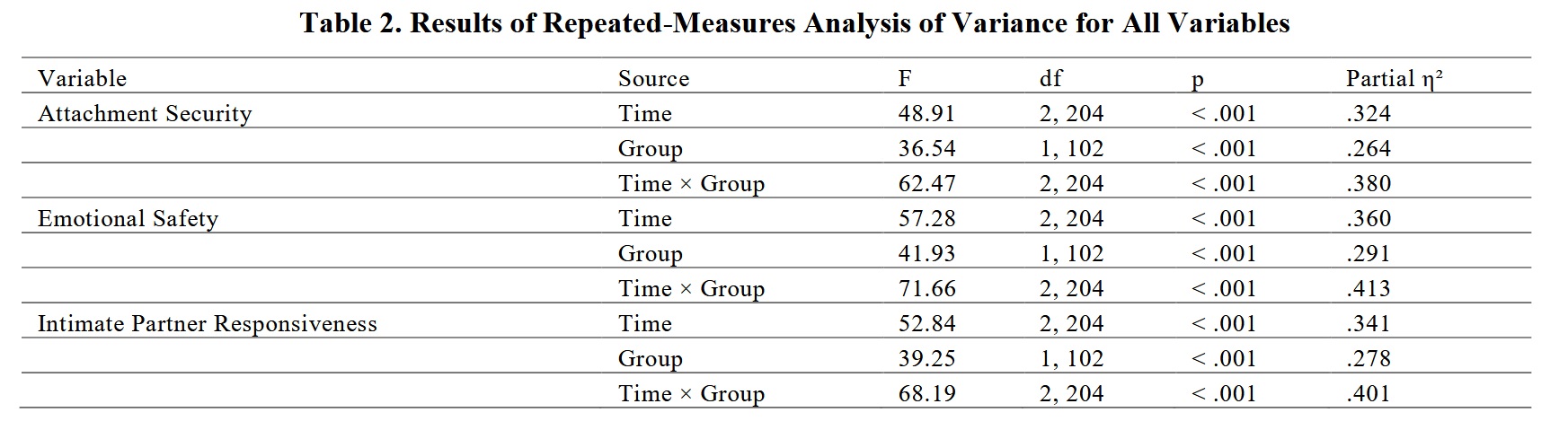
The present study aimed to examine the effectiveness of Trauma-Informed Couple Therapy (TICT) in improving attachment security, emotional safety, and intimate partner responsiveness among couples with childhood trauma histories. This quasi-experimental study employed a pre-test, post-test, and three-month follow-up design with an experimental group and a waitlist control group. The research was conducted in Canada among 52 couples (104 individuals) with documented childhood trauma histories who were recruited from community counseling centers and mental health clinics. Participants were assigned to either an experimental group (26 couples) receiving Trauma-Informed Couple Therapy or a control group (26 couples) receiving no intervention during the study period. Data were collected using the Experiences in Close Relationships-Revised Questionnaire (ECR-R) to assess attachment security, the Emotional Safety Scale for Couples (ESSC), and the Perceived Partner Responsiveness Scale (PPRS). The intervention consisted of twelve weekly 90-minute sessions integrating attachment-based, trauma-informed, emotionally focused, and relational resilience principles. Data were analyzed using repeated-measures analysis of variance and Bonferroni post hoc comparisons in SPSS version 29. The results of repeated-measures analysis of variance revealed significant Time × Group interaction effects for attachment security, F(2, 204) = 62.47, p < .001, η² = .380; emotional safety, F(2, 204) = 71.66, p < .001, η² = .413; and intimate partner responsiveness, F(2, 204) = 68.19, p < .001, η² = .401. Significant main effects of time and group were also observed across all outcome variables (p < .001). Bonferroni pairwise comparisons demonstrated significant improvements from pre-test to post-test and from pre-test to follow-up for attachment security, emotional safety, and intimate partner responsiveness in the experimental group (p < .001). No significant differences emerged between post-test and follow-up scores (p > .05), indicating maintenance of treatment gains over the three-month follow-up period. The large effect sizes obtained across all dependent variables suggest substantial intervention-related improvements in relational functioning among couples with childhood trauma histories. The findings indicate that Trauma-Informed Couple Therapy is an effective intervention for enhancing attachment security, emotional safety, and intimate partner responsiveness among couples affected by childhood trauma. By addressing trauma-related attachment disruptions, fostering emotionally safe interactions, and strengthening responsive relational processes, the intervention contributed to meaningful and sustained improvements in couple functioning. These results support the integration of trauma-informed and attachment-based approaches within couple therapy and highlight the importance of addressing the interpersonal consequences of childhood trauma in clinical practice.
Downloads
References
Allen, B. (2023). Attachment and Clinical Practice With Adults: Applications to Individual and Couple Therapy. 195-217. https://doi.org/10.1037/0000333-010
Barker, G. G., Volk, F., Hazel, J. S., & Reinhardt, R. A. (2021). Past Is Present: Pathways Between Childhood Sexual Abuse and Relationship Satisfaction. Journal of marital and family therapy, 48(2), 604-620. https://doi.org/10.1111/jmft.12522
Baumann, M., Daspe, M. È., Bélanger, C., & Godbout, N. (2024). A Safe Haven Through Attachment: A Dyadic Perspective on the Association Between Cumulative Childhood Trauma and Relationship Satisfaction. Journal of interpersonal violence, 40(9-10), 2093-2114. https://doi.org/10.1177/08862605241270013
Borden, L., & Allan, R. (2024). Integrating Sex Therapy With Emotionally Focused Therapy to Treat Sexual Desire Discrepancy. The Family Journal, 32(4), 522-530. https://doi.org/10.1177/10664807241264813
Braughton, J., Mendenhall, T. J., & Kazlauskaite, V. (2022). Identification of Resiliency Processes in Dual-Trauma Couples: An Exploration of Self-Reported Relational Strengths and Weaknesses. Psychological Trauma Theory Research Practice and Policy, 14(S1), S109-S118. https://doi.org/10.1037/tra0001112
Coffman, E., Goodrich, R. S., Gollery, T., Rujimora, J., Nelson, N., Park, C., Hile, E., & Torres, A. (2025). The Role of Relationship Education in Strengthening Attachment: Findings From the ELEVATE Program. The Family Journal. https://doi.org/10.1177/10664807251346974
Coffman, E., Swank, J. M., & Bayne, H. B. (2023). The Attachment Adaptation Process Model: Developing Attachment Security After Experiencing Addiction in the Family. Family Relations, 73(2), 1455-1473. https://doi.org/10.1111/fare.12920
Crawford, M. D., Butler, M. H., Marks, L. D., & Leavitt, C. J. (2023). Married Women's Response to Spousal Pornography Use: A Grounded Theory. Journal of marital and family therapy, 50(1), 95-119. https://doi.org/10.1111/jmft.12672
Espinoza, S., Davis, S. D., & Seshadri, G. (2024). Perceptions of the Effect of Parental Deportation on Adult Intimate Relationships. Journal of marital and family therapy, 50(2), 390-406. https://doi.org/10.1111/jmft.12697
Firestone, R. W. (2022). The Fantasy Bond in the Couple and Family. 25-43. https://doi.org/10.1037/0000268-003
Fitzgerald, M. (2022). Attachment as a Mediator Linking Childhood Maltreatment to Attributions in Adult Intimate Relationships. The Family Journal, 30(4), 562-569. https://doi.org/10.1177/10664807221104121
Freeman, B., Salivar, E. G., & Thayer, K. K. (2024). The Impact of the Military Lifestyle on Adult Military Children Relationships. Couple and Family Psychology Research and Practice, 13(1), 1-14. https://doi.org/10.1037/cfp0000252
Ganz, M. B., Rasmussen, H. F., McDougall, T. V., Corner, G. W., Black, T. T., & Hector, F. D. L. S. (2022). Emotionally Focused Couple Therapy Within VA Healthcare: Reductions in Relationship Distress, PTSD, and Depressive Symptoms as a Function of Attachment-Based Couple Treatment. Couple and Family Psychology Research and Practice, 11(1), 15-32. https://doi.org/10.1037/cfp0000210
George, C., & Aikins, J. W. (2023). Developing a Secure Base in Family Intervention: Using the Adult Attachment Projective System to Assess Attachment in Family Relationships. Frontiers in psychology, 14. https://doi.org/10.3389/fpsyg.2023.1291661
Gorden, A. (2025). Somatic Work in Couple Therapy. The Family Journal, 33(4), 509-517. https://doi.org/10.1177/10664807251348210
Henry, M. C., Burks, M., & Robertson, D. L. (2025). Emotionally Focused Therapy in Sexually Diverse Intimate Partnerships. The Family Journal, 34(1), 146-153. https://doi.org/10.1177/10664807251378706
Izett, E., Rooney, R., Prescott, S. L., Palma, M. D., & McDevitt, M. (2021). Prevention of Mental Health Difficulties for Children Aged 0–3 Years: A Review. Frontiers in psychology, 11. https://doi.org/10.3389/fpsyg.2020.500361
Linder, J. N., Niño, A., Negash, S., & Espinoza, S. (2022). Thematic Analysis of Therapists' Experiences Integrating EMDR and EFT in Couple Therapy: Theoretical and Clinical Complementarity, and Benefits to Client Couples. Journal of marital and family therapy, 48(3), 777-797. https://doi.org/10.1111/jmft.12587
Mirzazade, Z., Molazade, J., Hadianfard, H., & Taghavi, M. (2025). The Effect of Emotionally Focused Couple Therapy (EFCT) on Shame and Intimacy in Couples: A Randomized Controlled Trial (RCT). BMC psychology, 13(1). https://doi.org/10.1186/s40359-025-03415-3
Ørke, E. C., Bjørkly, S., Dufort, M., & Vatnar, S. K. B. (2021). Attachment Characteristics Among Women Victimized in No, One, and Multiple IPV Relationships: A Case–Control Study. Violence Against Women, 27(15-16), 2945-2970. https://doi.org/10.1177/1077801220981157
Paivio, S. C., & Pascual‐Leone, A. (2023). Trauma and Its Effects. 15-32. https://doi.org/10.1037/0000336-002
Ponting, C., Tomlinson, R. C., Chu, A. T., & Lieberman, A. F. (2023). Mitigating the Impact of Intimate Partner Violence in Pregnancy and Early Childhood: A Dyadic Approach to Psychotherapy. Family Court Review, 62(1), 112-130. https://doi.org/10.1111/fcre.12766
Quan, L., Zhang, K., & Chen, H. (2025). The Relationship Between Childhood Trauma and Romantic Relationship Satisfaction: The Role of Attachment and Social Support. Frontiers in Psychiatry, 15. https://doi.org/10.3389/fpsyt.2024.1519699
Rokach, A., & MacFarlane, K. (2021). Abused Children and Their Relationships as Adults. Psychology and Mental Health Care, 5(3), 01-14. https://doi.org/10.31579/2637-8892/144
Sokolova, M., & Bakalova, D. (2022). Intimate Partner Violence: An Application of Attachment Theory. Psychological Research (In the Balkans), 25(3). https://doi.org/10.7546/psyrb.2022.25.03.04
Southern, S., & Sullivan, R. D. (2021). Family Violence in Context: An Intergenerational Systemic Model. The Family Journal, 29(3), 260-291. https://doi.org/10.1177/10664807211006274
Tadros, E. (2024). Conceptualizing Couples Through Romantic Attachment and Love Language. The Family Journal, 33(4), 568-576. https://doi.org/10.1177/10664807241283038
Tadros, E., & Ansell, A. (2022). Romantic Attachment, Childhood Stability, Depression, and PTSD in Couples With an Incarcerated Partner. Journal of Forensic Sciences, 67(2), 619-629. https://doi.org/10.1111/1556-4029.14976
Xu, M., Rodríguez‐González, M., Calatrava, M., Sambuceti‐Lewis, A., & Martínez‐Díaz, M. P. (2025). Differentiation of Self, Attachment Experiences, and Dyadic Adjustment: An APIM Approach With Spanish‐Speaking Couples. Family Process, 65(1). https://doi.org/10.1111/famp.70105
Yakeley, J. (2021). The Search for Tailored Treatments: Discussion of Five Interventions for Perpetrators of Intimate Partner Violence. Journal of Clinical Psychology, 78(1), 80-98. https://doi.org/10.1002/jclp.23291
Zamir, O., Gewirtz‐Meydan, A., & Finzi‐Dottan, R. (2025). Childhood Maltreatment and Perceived Partner Responsiveness: A Dyadic Analysis of Posttraumatic Symptoms as a Mediator. Psychological Trauma Theory Research Practice and Policy. https://doi.org/10.1037/tra0002048

Downloads
Published
Submitted
Revised
Accepted
Issue
Section
License
Copyright (c) 2026 Kannaiah Chattu (Author); Refuwe khuto

This work is licensed under a Creative Commons Attribution-NonCommercial 4.0 International License.