Machine Learning-Based Classification of High-Conflict Couples Using Psychological, Relational, and Behavioral Interaction Features
Keywords:
Machine learning, high-conflict couples, marital conflict, dyadic adjustment, emotional intimacy, attachment insecurityAbstract
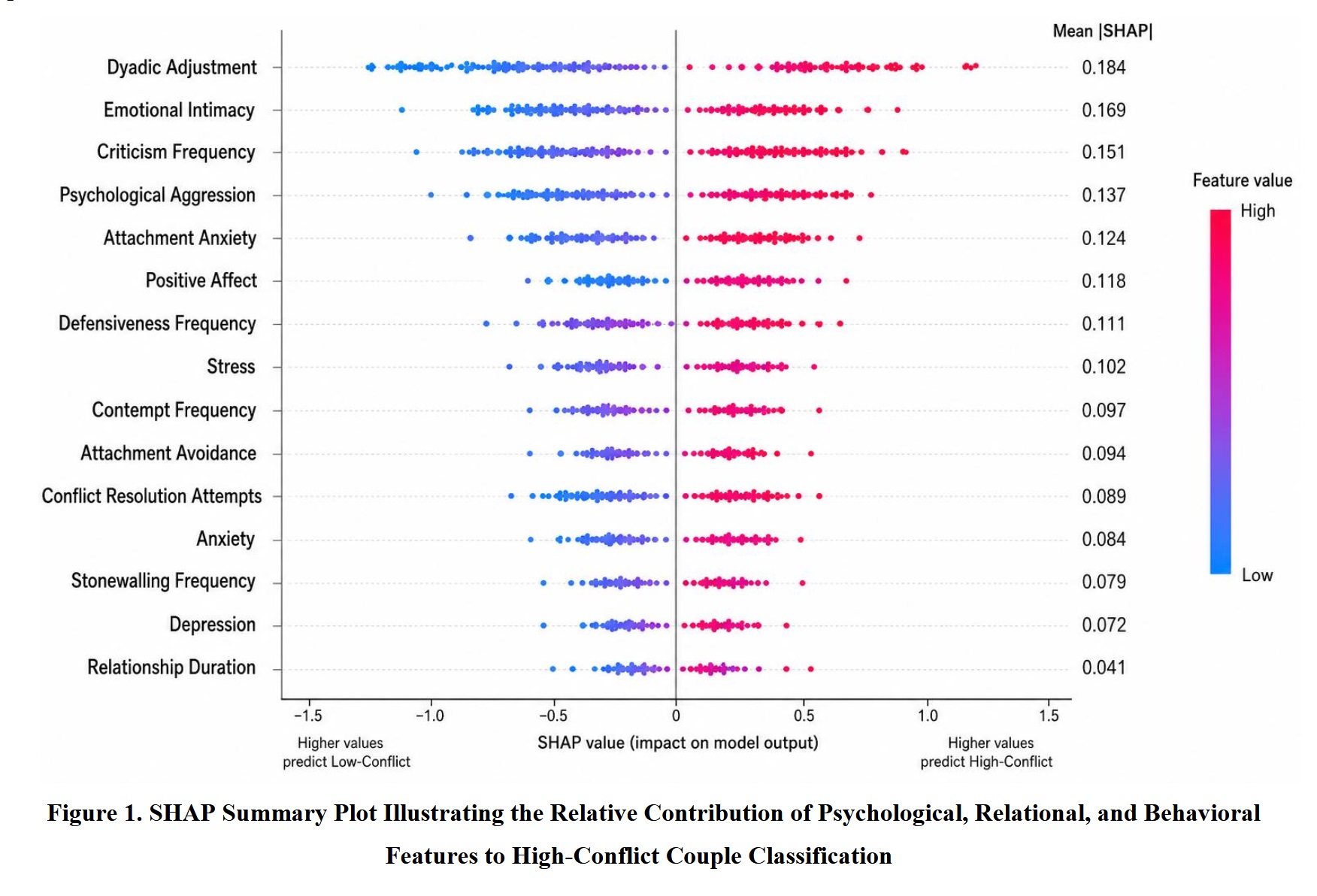
The present study aimed to develop and evaluate machine learning models for the classification of high-conflict couples using psychological characteristics, relational functioning indicators, and behavioral interaction features while identifying the most influential predictors of relationship conflict status. This cross-sectional predictive study was conducted among 624 couples (N = 1,248 individuals) recruited from multiple urban and suburban regions of Malaysia. Participants completed a comprehensive assessment battery measuring depression, anxiety, stress, attachment insecurity, emotional intimacy, dyadic adjustment, and conflict behaviors. In addition, couples participated in structured conflict discussion tasks that were coded for behavioral interaction features, including criticism, defensiveness, contempt, stonewalling, positive affect, and conflict resolution attempts. Following data preprocessing procedures, including normalization, missing-value imputation, and feature engineering, the dataset was divided into training and testing subsets using stratified sampling. Several supervised machine learning algorithms, including Logistic Regression, Support Vector Machine, Random Forest, Gradient Boosting, Artificial Neural Network, and Extreme Gradient Boosting (XGBoost), were trained and compared. Model performance was evaluated using accuracy, precision, recall, F1-score, and area under the receiver operating characteristic curve (AUC-ROC). SHapley Additive exPlanations (SHAP) analyses were conducted to determine feature importance and model interpretability. All machine learning models demonstrated satisfactory predictive performance; however, ensemble learning algorithms significantly outperformed traditional approaches. XGBoost emerged as the best-performing model, achieving an accuracy of 94.1%, precision of 93.7%, recall of 93.3%, F1-score of 93.5%, and an AUC-ROC value of 0.978. Feature importance analyses revealed that dyadic adjustment, emotional intimacy, criticism frequency, psychological aggression, attachment anxiety, positive affect, defensiveness frequency, and stress were the strongest contributors to classification accuracy. High-conflict couples exhibited significantly higher levels of psychological distress, attachment insecurity, aggression, and dysfunctional communication behaviors, whereas low-conflict couples demonstrated greater emotional intimacy, relationship satisfaction, positive affect, and constructive conflict resolution patterns. The confusion matrix further indicated high sensitivity and specificity, confirming the robustness and generalizability of the classification model. The findings demonstrate that machine learning approaches can accurately distinguish high-conflict couples from low-conflict couples by integrating psychological, relational, and behavioral interaction variables. The results highlight the multidimensional nature of relationship conflict and suggest that relational functioning indicators and observed communication behaviors represent particularly powerful predictors of conflict status. Machine learning-based assessment frameworks may provide valuable tools for early identification, risk assessment, personalized intervention planning, and the development of data-driven approaches to couple therapy and relationship education.
Downloads
References
Arab, A., & Khodabakhshi‐Koolaee, A. (2022). The Magic of WDEP in Reality Therapy. European Journal of Psychology Open, 81(3), 97-103. https://doi.org/10.1024/2673-8627/a000029
Bafrani, M. A., Nourizadeh, R., Hakimi, S., Mortazavi, S. M. J., Mehrabi, E., & Vahed, N. (2023). The Effect of Psychological Interventions on Sexual and Marital Satisfaction: A Systematic Review and Meta-Analysis. Iranian Journal of Public Health. https://doi.org/10.18502/ijph.v52i1.11666
Bagheri, S., Pasha, R., Saadi, Z. E., Hafezi, F., & Naderi, F. (2024). Comparing the Efficacy of Bowen Family Systems Therapy and Couple Therapy Based on Integrated Behavioral Systems on Marital Intimacy and Family Functions. Aftj, 5(1), 56-68. https://doi.org/10.61838/kman.aftj.5.1.7
Biesen, J. N., Roddy, M. K., & Doss, B. D. (2024). The Role of Five-Factor Model Personality Traits in a Web-Based Relationship Improvement Program. Couple and Family Psychology Research and Practice, 13(2), 117-133. https://doi.org/10.1037/cfp0000221
Carr, A. (2025). Couple Therapy and Systemic Interventions for Adult‐focused Problems: The Evidence Base. Journal of Family Therapy, 47(1). https://doi.org/10.1111/1467-6427.12481
Darwiche, J., Antonietti, J. P., Nunes, C. E., Favez, N., Liekmeier, E., & Roten, Y. d. (2022). Couple Therapy With Parents: Results From a Pragmatic Randomized Controlled Trial Testing the Integrative Brief Systemic Intervention (IBSI). Journal of marital and family therapy, 49(2), 351-369. https://doi.org/10.1111/jmft.12625
Darwiche, J., Carneiro, C., Vaudan, C., Imesch, C., Nunes, C. E., Favez, N., & Roten, Y. d. (2022). Parents in Couple Therapy: An Intervention Targeting Marital and Coparenting Relationships. Family Process, 61(2), 490-506. https://doi.org/10.1111/famp.12773
Darwiche, J., Nunes, C. E., Ghaziri, N. E., Imesch, C., & Bessero, S. (2021). Coparenting Interventions and Shared Physical Custody: Insights and Challenges. 253-282. https://doi.org/10.1007/978-3-030-68479-2_12
Dattilio, F. M., & Epstein, N. B. (2021). Cognitive Behavioral Couple and Family Therapy. 513-548. https://doi.org/10.1037/0000219-016
Fentz, H. N., Hansen, F. G., & Trillingsgaard, T. (2025). Evaluating the OurRelationship Program Among Easy-to-Reach Distressed Couples: A Randomized Pilot Study. Couple and Family Psychology Research and Practice. https://doi.org/10.1037/cfp0000297
Gil, M., Kim, S. S., Kim, D., & Kim, S. (2023). Online Coaching Blended Couple‐oriented Intervention for Preventing Depression Among Korean Middle Adulthood: A Feasibility Study. Family Process, 62(4), 1478-1505. https://doi.org/10.1111/famp.12924
Gorden, A. (2025). Somatic Work in Couple Therapy. The Family Journal, 33(4), 509-517. https://doi.org/10.1177/10664807251348210
Hatch, S., Knopp, K., Le, Y., Allen, M. O. T., Rothman, K., Rhoades, G. K., & Doss, B. D. (2021). Online Relationship Education for Help‐seeking Low‐income Couples: A Bayesian Replication and Extension of the OurRelationship and ePREP Programs. Family Process, 61(3), 1045-1061. https://doi.org/10.1111/famp.12710
Hoss, L., Richardson, L., Axelrod, A. D., & Cravens, J. D. (2023). Clinical Guidelines When Addressing Abuse Over Telemental Health. Contemporary Family Therapy, 45(3), 287-297. https://doi.org/10.1007/s10591-023-09665-w
Irvine, T. J., Peluso, P. R., Benson, K., Cole, C., Cole, D. L., Gottman, J. M., & Gottman, J. S. (2023). A Pilot Study Examining the Effectiveness of Gottman Method Couples Therapy Over Treatment-as-Usual Approaches for Treating Couples Dealing With Infidelity. The Family Journal, 32(1), 81-94. https://doi.org/10.1177/10664807231210123
Jamali, M., Heidari, H., Davoodi, H., & Ghaffari, K. (2024). Comparison of the Effectiveness of the Satir Communication Model and Compassion-Based Cognitive Behavioral Therapy on Behavioral Flexibility and Anxiety Sensitivity in Couples With Marital Conflict. Jarac, 6(1), 45-55. https://doi.org/10.61838/kman.jarac.6.1.5
Javaheri, M., Aghayousefi, A., & Gharamaleki, N. S. (2024a). Comparison of the Effectiveness of Therapist-Assisted Couple Therapy and Emotion-Focused Couple Therapy on Psychological Well-Being, Negotiation Enhancement, and Aggression Reduction in Women Victims of Spousal Violence. Aftj, 5(2), 190-199. https://doi.org/10.61838/kman.aftj.5.2.21
Javaheri, M., Aghayousefi, A., & Gharamaleki, N. S. (2024b). Effectiveness of Therapist-Assisted Couple Therapy on Psychological Well-Being, Negotiation Increase, and Aggression Reduction in Women Victims of Partner Violence. Jarac, 6(1), 133-141. https://doi.org/10.61838/kman.jarac.6.1.15
Joseph, B., Joseph, V., & Rajan, S. K. (2025). Effectiveness of Couple Interventions in Marital Distress: A Systematic Review and Meta-Analysis. Iranian Journal of Public Health. https://doi.org/10.18502/ijph.v54i1.17581
Keller, A., Babl, A., Berger, T., & Schindler, L. (2021). Efficacy of the Web-Based PaarBalance Program on Relationship Satisfaction, Depression and Anxiety – A Randomized Controlled Trial. Internet Interventions, 23, 100360. https://doi.org/10.1016/j.invent.2020.100360
Khalifian, C. E., Rashkovsky, K., Mitchell, E., Bismark, A. W., Wagner, A. C., & Knopp, K. (2024). A Novel Framework for Ketamine-Assisted Couple Therapy. Frontiers in Psychiatry, 15. https://doi.org/10.3389/fpsyt.2024.1376646
Kim, S. S., Gil, M., & Kim, D. (2022). Development of an Online-Coaching Blended Couple-Oriented Intervention for Preventing Depression in Middle Adulthood: An Intervention Mapping Study. Frontiers in Public Health, 10. https://doi.org/10.3389/fpubh.2022.882576
Lebow, J. L., Fisher, A. R., & Swanson, S. E. (2024). Couple Theory in Psychotherapy. 191-206. https://doi.org/10.1037/0000353-012
Liekmeier, E., Darwiche, J., Pinna, L., Repond, A., & Antonietti, J. P. (2021). Affective Behavior in Parent Couples Undergoing Couple Therapy: Contrasting Case Studies. Frontiers in psychology, 12. https://doi.org/10.3389/fpsyg.2021.634276
Littlechild, B., Scott, R., Taylor, B. J., & Przeperski, J. (2024). Relational Interventions for Intimate Partner Violence: A Systematic Narrative Review. Research on Social Work Practice, 35(7), 809-827. https://doi.org/10.1177/10497315241287915
MacIntosh, H. B. (2024). Developmental Couple Therapy for Complex Trauma: Results of an Implementation Pilot Study. Journal of marital and family therapy, 50(3), 545-566. https://doi.org/10.1111/jmft.12711
McCrady, B. S. (2021). The Role of the Family in Alcohol Use Disorder Recovery for Adults. Alcohol Research Current Reviews, 41(1). https://doi.org/10.35946/arcr.v41.1.06
Naseh, M., Badiezadeh, S., Rafieifar, M., Taridashti, S., Reddy, S. M., & Panisch, L. S. (2024). Solution‐Focused Brief Therapy for Improving Couple Dyadic Relationships in Iran: A Systematic Review. Journal of marital and family therapy, 51(1). https://doi.org/10.1111/jmft.12758
Renata Campos Moreira de Souza, C., & Teodoro, M. L. M. (2022). Efeitos De Um Programa Online Para Resolução De Conflitos Conjugal Functional. Revista Brasileira De Terapias Cognitivas, 18(1). https://doi.org/10.5935/1808-5687.20220005
Smith, T. W. (2022). Intimate Relationships and Coronary Heart Disease: Implications for Risk, Prevention, and Patient Management. Current Cardiology Reports, 24(6), 761-774. https://doi.org/10.1007/s11886-022-01695-4
Talib, M. A., Guo, J., Nordin, N. M., & Anne Noor Sri Juwaneeta, J. (2025). Integrative Behavioral Couple Therapy (IBCT) for Marital Reconciliation: A Systematic Review of Outcomes. The Family Journal, 34(1), 54-64. https://doi.org/10.1177/10664807251384198
Thompson, J. (2021). The Effectiveness of Couple Therapy on Psychological and Relational Variables and Pregnancy Rates in Couples With Infertility: A Systematic Review. Australian and New Zealand Journal of Family Therapy, 42(2), 120-144. https://doi.org/10.1002/anzf.1446
Trillingsgaard, T., Hansen, F. G., & Fentz, H. N. (2025). Comparing the OurRelationship Program and Bibliotherapy for Parents Experiencing Couple Distress: A Randomized Pilot. Journal of marital and family therapy, 51(1). https://doi.org/10.1111/jmft.12762
Tseng, C. F. (2025). Emotion Access and Navigation in Chinese Couples: Insights and Adaptations From Emotionally Focused Couples Therapy Therapists. Journal of marital and family therapy, 52(1). https://doi.org/10.1111/jmft.70093
Worthington, E. L., Ripley, J. S., Chen, Z. J., Kent, V. M., & Loewer, E. (2023). Spiritually Integrated Couple Therapy. 347-363. https://doi.org/10.1037/0000338-018
Yıldızhan, C., Kafesçioğlu, N., Zeytinoğlu‐Saydam, S., Erdem, G., Söylemez, Y., & Yumbul, Ç. (2024). Emotion Regulation in Emotionally Focused Therapists Working With High‐conflict Couples. Journal of marital and family therapy, 50(4), 840-866. https://doi.org/10.1111/jmft.12725
Yu, F., Ahmed, I., Salerno, R., & Sarli, T. (2022). Yes or No: Using Narrative Therapy to Help Couples With Childbearing Decision Conflict. The Family Journal, 31(1), 51-59. https://doi.org/10.1177/10664807221126195

Downloads
Published
Submitted
Revised
Accepted
Issue
Section
License
Copyright (c) 2026 Xiangyuan Ma, Fernanda Ahmad (Author); Naziren Qureshi

This work is licensed under a Creative Commons Attribution-NonCommercial 4.0 International License.