The Structural Association between Perceived Stress, Dyadic Coping, Relationship Commitment, and Marital Resilience
Keywords:
Perceived Stress, Dyadic Coping, Relationship Commitment, Marital ResilienceAbstract
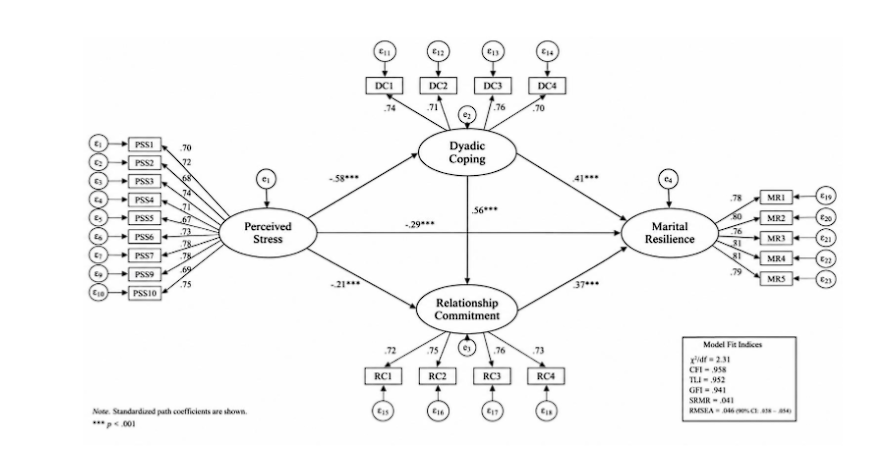
The present study aimed to examine the structural association between perceived stress, dyadic coping, relationship commitment, and marital resilience among married individuals in Baku, with particular emphasis on the direct and indirect pathways through which perceived stress influences marital resilience. This cross-sectional correlational study was conducted using structural equation modeling (SEM). The study population consisted of married individuals residing in Baku, Azerbaijan, during the 2025–2026 period. A total of 624 participants were selected through community-based and convenience sampling methods. Data were collected using the Perceived Stress Scale (PSS-10), Dyadic Coping Inventory (DCI), Commitment Inventory, and Marital Resilience Scale. Descriptive statistics, Pearson correlation analyses, confirmatory factor analysis, and structural equation modeling were performed using SPSS version 29 and AMOS version 29. Model fit was evaluated using multiple fit indices, including χ²/df, CFI, TLI, GFI, SRMR, and RMSEA. Indirect effects were tested using bootstrap procedures with 5,000 resamples and 95% confidence intervals. The proposed structural model demonstrated excellent fit to the data (χ²/df = 2.31, CFI = .958, TLI = .952, GFI = .941, SRMR = .041, RMSEA = .046). Perceived stress had significant negative direct effects on dyadic coping (β = -0.58, p < .001), relationship commitment (β = -0.21, p < .001), and marital resilience (β = -0.29, p < .001). Dyadic coping exerted significant positive effects on relationship commitment (β = 0.56, p < .001) and marital resilience (β = 0.41, p < .001). Relationship commitment also positively predicted marital resilience (β = 0.37, p < .001). Bootstrap analyses revealed significant indirect effects of perceived stress on marital resilience through dyadic coping (β = -0.24, p < .001), relationship commitment (β = -0.08, p < .001), and the sequential pathway involving dyadic coping and relationship commitment (β = -0.12, p < .001). The model explained 34% of the variance in dyadic coping, 46% of the variance in relationship commitment, and 71% of the variance in marital resilience. The findings indicate that perceived stress undermines marital resilience both directly and indirectly by weakening dyadic coping and relationship commitment. Dyadic coping emerged as a central protective factor that strengthens commitment and enhances resilience within marriage. These results highlight the importance of collaborative coping processes and relational dedication in fostering adaptive functioning among couples and suggest that interventions targeting stress management, dyadic coping, and commitment may contribute substantially to the promotion of marital resilience.
Downloads
References
Bertschi, I., Meier, F., & Bodenmann, G. (2021). Disability as an Interpersonal Experience: A Systematic Review on Dyadic Challenges and Dyadic Coping When One Partner Has a Chronic Physical or Sensory Impairment. Frontiers in psychology, 12. https://doi.org/10.3389/fpsyg.2021.624609
Buchanan, D. A. (2022). Examining the Marital Relationship After the Death of a Child. The Family Journal, 31(1), 165-173. https://doi.org/10.1177/10664807221104129
Budiartini, N. N. (2021). Effect of Covid-19 Related Stress on Marital Quality During Covid-19 Pandemic. Psychological Research and Intervention, 4(1), 9-18. https://doi.org/10.21831/pri.v4i1.43287
Campbell, A., Landers, A. L., & Jackson, J. B. (2022). I Have to Hold It Together: Trauma in Law Enforcement Couples. Family Relations, 71(4), 1593-1618. https://doi.org/10.1111/fare.12661
Candel, O. S., & Jitaru, M. (2021). COVID-19 and Romantic Relationships. Encyclopedia, 1(4), 1038-1046. https://doi.org/10.3390/encyclopedia1040079
Carrese‐Chacra, E., Hollett, K. B., Erdem, G., Miller, S., & Gouin, J. P. (2023). Longitudinal Effects of Pandemic Stressors and Dyadic Coping on Relationship Satisfaction During the COVID‐19 Pandemic. Family Relations, 72(3), 645-664. https://doi.org/10.1111/fare.12885
Cıhan, H., & Var, E. Ç. (2022). Developing a Model on the Factors Affecting Family Resilience in the COVID-19 Pandemic: Risk and Protective Factors. Current Psychology, 42(23), 20259-20274. https://doi.org/10.1007/s12144-022-03008-y
Cui, P., Shi, J., Li, S., Getu, M. A., Wang, R., & Chen, C. (2023). Family Resilience and Its Influencing Factors Among Advanced Cancer Patients and Their Family Caregivers: A Multilevel Modeling Analysis. BMC Cancer, 23(1). https://doi.org/10.1186/s12885-023-11101-z
Estlein, R., Gewirtz‐Meydan, A., & Opuda, E. (2022). Love in the Time of COVID‐19: A Systematic Mapping Review of Empirical Research on Romantic Relationships One Year Into the COVID‐19 Pandemic. Family Process, 61(3), 1208-1228. https://doi.org/10.1111/famp.12775
Fan, Z., Wu, H., Tao, M., & Chen, L. (2022). Relationship Between Chinese Middle-Aged and Old Couples' Confucian Coping Thinking and Marital Quality. Frontiers in Public Health, 10. https://doi.org/10.3389/fpubh.2022.956214
Fergus, K., Ahmad, S., Gardner, S., Ianakieva, I., McLeod, D., Stephen, J., Carter, W., Periera, A., Warner, E., & Panchaud, J. (2021). Couplelinks Online Intervention for Young Couples Facing Breast Cancer: A Randomised Controlled Trial. Psycho-Oncology, 31(3), 512-520. https://doi.org/10.1002/pon.5836
Grané-Morcillo, J. (2026). Adaptation and Validation of the Couple Resilience Inventory (CRI) in a Portuguese Sample. European Journal of Psychology Open. https://doi.org/10.1024/2673-8627/a000096
Hasanzadeh, M., Samavati, M., & Javaheri, A. (2024). Effectiveness of Couples Coping Enhancement Training on Resilience and Marital Conflict During the Transition to Parenthood. Aftj, 5(2), 46-54. https://doi.org/10.61838/kman.aftj.5.2.6
Ji, Y., Xue, L., & Chen, L. (2025). Cross-Lagged Analysis of Interdependence and Psychological Symptom Clusters in Postpartum Women: A Prospective Study. Medicine, 104(44), e45709. https://doi.org/10.1097/md.0000000000045709
Kurt, İ. E., & Yaman, S. A. (2025). Dyadic Coping and Spousal Support: The Moderating Role of Psychological Flexibility. https://doi.org/10.21203/rs.3.rs-6411626/v1
Lillie, H. M., Chernichky‐Karcher, S., & Venetis, M. K. (2021). Dyadic Coping and Discrete Emotions During COVID-19: Connecting the Communication Theory of Resilience With Relational Uncertainty. Journal of Social and Personal Relationships, 38(6), 1844-1868. https://doi.org/10.1177/02654075211009302
Lucier‐Greer, M., Frye, N., Reed‐Fitzke, K., Ferraro, A. J., & Mancini, J. A. (2022). Military‐related Stress, Self‐efficacy, and Anxiety: Investigating the Role of Marital Quality in Military Couples. Family Process, 62(3), 1253-1271. https://doi.org/10.1111/famp.12833
Mohamad, Z. S., Bakar, K. A. A., ucsiuniversity.edu.my, A. M. K., Sallehudin, F. U., & May, W. G. C. (2022). The Positive State and Positive Mindset in Building a Positive Relationship: A Review Paper. Malaysian Journal of Social Sciences and Humanities (MJSSH), 7(7), e001640. https://doi.org/10.47405/mjssh.v7i7.1640
Ogan, M. A., & Monk, J. K. (2025). Does Stress Promote or Inhibit Romantic Partner Support? A Systematic Review of Competing Hypotheses. Journal of Family Theory & Review, 17(3), 742-773. https://doi.org/10.1111/jftr.12633
Ogan, M. A., Monk, J. K., Kanter, J. B., & Proulx, C. M. (2021). Stress, Dyadic Coping, and Relationship Instability During the COVID-19 Pandemic. Journal of Social and Personal Relationships, 38(10), 2944-2964. https://doi.org/10.1177/02654075211046531
Pavon, M. V., Jakab, A. W., & Löw, A. (2024). Exploring Relationship Satisfaction in Mothers of Children With Disabilities: The Predictive Role of Interparental Conflicts and Moderating Role of Dyadic Coping. Frontiers in Psychiatry, 14. https://doi.org/10.3389/fpsyt.2023.1307827
Pietromonaco, P. R., & Overall, N. C. (2022). Implications of Social Isolation, Separation, and Loss During the COVID-19 Pandemic for Couples' Relationships. Current opinion in psychology, 43, 189-194. https://doi.org/10.1016/j.copsyc.2021.07.014
Qiu, X., Mao, J., Wang, C., Yang, X., & Li, Q. (2024). Family Resilience and Its Influencing Factors in Patients With Cancer and Their Family Members: A Systematic Review. Journal of clinical nursing, 34(4), 1124-1148. https://doi.org/10.1111/jocn.17485
Russell, J. A., Skipper, A. D., Rose, A. H., & Kennedy, J. L. (2021). Sanctification of Couple Relationships and Communal Coping in Married and Cohabiting African American Couples. Journal of Family Psychology, 35(8), 1128-1137. https://doi.org/10.1037/fam0000882
Santamaría‐Gutiez, R., Martínez‐Corredor, S., González‐Sala, F., & Lacomba‐Trejo, L. (2025). Relevance of Positive Dyadic Coping for Couples Undergoing Assisted Reproduction Treatments: A Systematic Review. Journal of marital and family therapy, 51(2). https://doi.org/10.1111/jmft.70016
Seok, C. B., Ismail, R., Mutang, J. A., Yee, H. K., Siau, C. S., Fitriana, M., & Yun, L. W. (2022). The Role of Dyadic Coping in Married/Cohabiting Adults’ Well-Being and Relationship Quality During COVID-19 Pandemic Lockdown in Malaysia. International journal of health sciences, 47052-47065. https://doi.org/10.53730/ijhs.v6ns7.13095
Shinan‐Altman, S., Wertheimer, A., Frankel, B.-E., & Hamama‐Raz, Y. (2024). Her, His, and Their Journey With Endometriosis: A Qualitative Study. Frontiers in Global Women S Health, 5. https://doi.org/10.3389/fgwh.2024.1480060
Surijah, E. A., Murray, K., & Shochet, I. M. (2025). The Compensatory Model of Resilience Process of Indonesian Married Individuals. Journal of marriage and family, 88(1), 299-310. https://doi.org/10.1111/jomf.70016
Valente, M., Chirico, I., Ottoboni, G., & Chattat, R. (2021). Relationship Dynamics Among Couples Dealing With Breast Cancer: A Systematic Review. International journal of environmental research and public health, 18(14), 7288. https://doi.org/10.3390/ijerph18147288
Wang, Y., & Umberson, D. (2022). Dyadic Coping and Marital Quality in Same-Sex and Different-Sex Marriages. Journal of Social and Personal Relationships, 40(3), 996-1017. https://doi.org/10.1177/02654075221123096
Wang, Y., Xu, S., Yu, H., Yi, L., & Jia, D. (2025). Interactions Among Dyadic Coping, Self-Efficacy, and Negative Emotions in Chinese Parents of Children With Leukemia. BMC psychology, 13(1). https://doi.org/10.1186/s40359-025-02525-2
Xiang, E., Zhang, X., Raza, S. A., Oluyomi, A., Amos, C. I., & Badr, H. (2022). Risk and Resilience in Couple’s Adjustment to the COVID-19 Pandemic. Journal of Social and Personal Relationships, 39(11), 3252-3274. https://doi.org/10.1177/02654075221094556
Zhang, Q., & Cao, H. (2024). Relationships Between Dyadic Coping, Marital Adjustment, and Post-Traumatic Growth in Patients With Maintenance Hemodialysis Patients and Their Spouses. Frontiers in psychology, 15. https://doi.org/10.3389/fpsyg.2024.1487355

Downloads
Published
Submitted
Revised
Accepted
Issue
Section
License
Copyright (c) 2026 Azar Aliyev (Author); Orkhan Huseinov; Hakan çetinkaya (Author)

This work is licensed under a Creative Commons Attribution-NonCommercial 4.0 International License.