Testing a Dyadic Model of Romantic Jealousy, Reassurance Seeking, Partner Monitoring, and Relationship Instability
Keywords:
Romantic jealousy, reassurance seeking, partner monitoring, relationship instability, Actor–Partner Interdependence Model, dyadic analysis, attachment insecurity, romantic relationships, electronic partner surveillanceAbstract
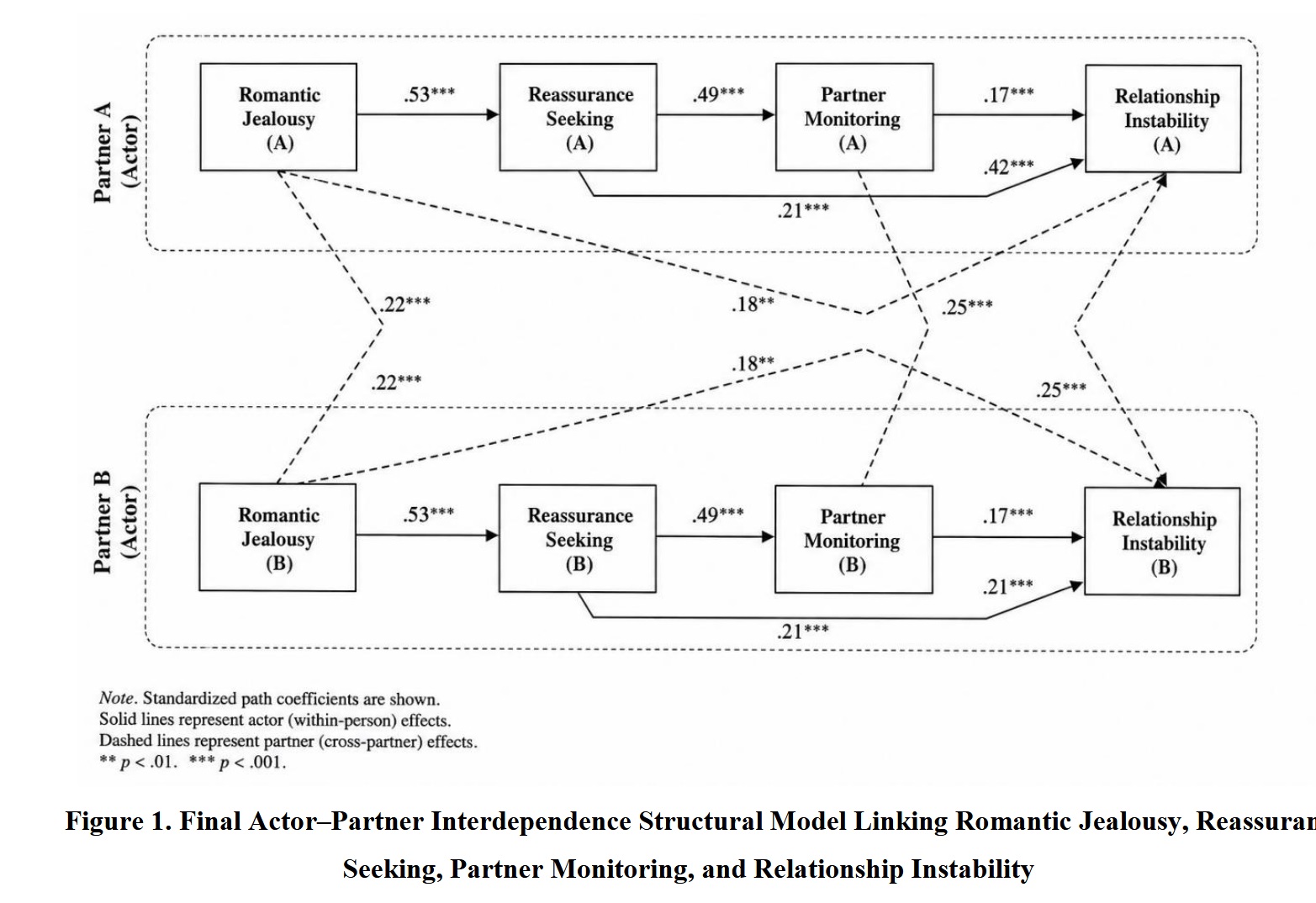
The present study aimed to test a dyadic model examining the direct and indirect associations among romantic jealousy, reassurance seeking, partner monitoring, and relationship instability by simultaneously evaluating actor and partner effects within romantic couples. This cross-sectional correlational study was conducted among 412 romantic couples (N = 824 individuals) residing in the United States. Participants were recruited through online platforms, community organizations, and university participant pools and were required to be at least 18 years old and involved in a committed romantic relationship for a minimum of six months. Data were collected using the Multidimensional Jealousy Scale, Reassurance-Seeking Scale, Partner Monitoring Scale, and Marital Instability Index. Descriptive statistics, reliability analyses, and Pearson correlations were performed using SPSS version 29. Dyadic relationships among variables were examined through the Actor–Partner Interdependence Model (APIM) within a structural equation modeling framework using AMOS version 29. Model fit was evaluated using χ²/df, CFI, TLI, RMSEA, and SRMR indices, and indirect effects were tested through bootstrapping procedures with 5,000 resamples. Results indicated significant positive associations among romantic jealousy, reassurance seeking, partner monitoring, and relationship instability (all p < .001). The proposed dyadic structural model demonstrated excellent fit to the data (χ²/df = 2.24, CFI = .967, TLI = .961, RMSEA = .039, SRMR = .041). Actor effects revealed that romantic jealousy significantly predicted reassurance seeking (β = .53, p < .001), partner monitoring (β = .49, p < .001), and relationship instability (β = .17, p < .001). Reassurance seeking (β = .21, p < .001) and partner monitoring (β = .42, p < .001) significantly predicted relationship instability. Significant partner effects were also observed, indicating that one partner’s jealousy predicted the other partner’s monitoring behaviors (β = .22, p < .001) and relationship instability (β = .18, p = .001), while partner monitoring predicted the partner’s instability (β = .25, p < .001). Bootstrapping analyses confirmed significant indirect effects of jealousy on relationship instability through reassurance seeking (β = .11, p < .001) and partner monitoring (β = .21, p < .001). The findings support a comprehensive dyadic model in which romantic jealousy contributes to relationship instability both directly and indirectly through reassurance-seeking and partner-monitoring behaviors. The results highlight the importance of considering emotional insecurity as an interpersonal process that affects both members of a romantic dyad. Reassurance seeking and monitoring behaviors appear to function as key mechanisms through which jealousy undermines relationship stability. These findings underscore the value of dyadic perspectives in relationship research and suggest that interventions targeting insecurity, excessive reassurance seeking, and partner surveillance may enhance relationship functioning and long-term stability.
Downloads
References
Blayney, R., & Burgess, M. (2023). Identifying Points for Therapeutic Intervention From the Lived Experiences of People Seeking Help for Retroactive Jealousy. Counselling and Psychotherapy Research, 24(2), 591-599. https://doi.org/10.1002/capr.12697
Bui, V., & Moscovitch, D. A. (2024). Predictors of Excessive Reassurance Seeking in Social Anxiety. Cognitive therapy and research, 48(2), 292-302. https://doi.org/10.1007/s10608-024-10473-1
Conradi, H. J. (2022). Relative Contributions of Actor and Partner Forgiveness and Attachment to Couples' Functioning. Family Relations, 72(3), 1032-1048. https://doi.org/10.1111/fare.12754
Conradi, H. J., Noordhof, A., & Kamphuis, J. H. (2021). Satisfying and Stable Couple Relationships: Attachment Similarity Across Partners Can Partially Buffer the Negative Effects of Attachment Insecurity. Journal of marital and family therapy, 47(3), 682-697. https://doi.org/10.1111/jmft.12477
Evraire, L. E., Dozois, D. J. A., & Wilde, J. L. (2022). The Contribution of Attachment Styles and Reassurance Seeking to Trust in Romantic Couples. Europe’s Journal of Psychology, 18(1), 19-39. https://doi.org/10.5964/ejop.3059
Genç, E. (2026). The Impact of Obsessive‐Compulsive Relationship Symptoms on Marital Instability: Mediating Role of Infidelity Tendency. Journal of marital and family therapy, 52(2). https://doi.org/10.1111/jmft.70122
Gewirtz‐Meydan, A., Estlein, R., & Finzi‐Dottan, R. (2023). The Relationship Between Narcissistic Traits and Attitudes Toward Infidelity: A Dyadic Analysis. Journal of Family Psychology, 37(6), 932-941. https://doi.org/10.1037/fam0001126
Gosselin, C., Daspe, M. È., Brassard, A., Lussier, Y., & Vaillancourt‐Morel, M. P. (2024). Attachment as an Intermediary Variable Between Childhood Maltreatment and Perceived Partner Responsiveness in Adolescents and Young Adults. Journal of marital and family therapy, 50(2), 434-452. https://doi.org/10.1111/jmft.12688
Hart, C. M., Carnelley, K. B., Vowels, L. M., & Thomas, T. (2025). Phubbed and Furious: Narcissists’ Responses to Perceived Partner Phubbing. Behavioral Sciences, 15(7), 853. https://doi.org/10.3390/bs15070853
Jaurequi, M. E., Kimmes, J. G., Seibert, G. S., Ledermann, T., & Roberts, K. (2023). The Role of Mindfulness Between Adult Attachment and Anxiety: A Dyadic Approach. Couple and Family Psychology Research and Practice, 12(3), 132-145. https://doi.org/10.1037/cfp0000197
Jean, M., Brassard, A., Boon, S. D., Lafontaine, M. F., Mondor, J., & Péloquin, K. (2024). “I Did Not Expect That From You!”: Unforgiveness Dimensions, Attachment Insecurities, and Relationship Under‐commitment Following a Relational Transgression. Personal Relationships, 31(4), 1047-1066. https://doi.org/10.1111/pere.12568
Karaköse, S., & Ledermann, T. (2026). Insecure Attachment and Mental Health in Married Couples. Couple and Family Psychology Research and Practice, 15(1), 16-31. https://doi.org/10.1037/cfp0000276
Knox, L., Karantzas, G. C., Ferguson, E., & Lawless, N. (2023). A Dyadic Analysis of Partner Maltreatment Using an Attachment-Based Diathesis–stress Model: A Lab-Based Study. Psychology of violence, 13(2), 149-160. https://doi.org/10.1037/vio0000439
Laforte, S., Paradis, A., Todorov, E. H., & Cyr, C. (2023). Romantic Attachment and Cyber Dating Violence in Adolescence: A Dyadic Approach. Journal of adolescence, 95(4), 647-660. https://doi.org/10.1002/jad.12141
Langlais, M. R., Shufford, K. N., Citrano, E., Lau, K. K., & Randall, A. K. (2023). To Scroll or Not to Scroll: Examining Social Media as a Mediator for Attachment Security and Internal Stress. American Journal of Social Sciences and Humanities, 8(1), 129-144. https://doi.org/10.55284/ajssh.v8i1.878
Leclerc, M.-È., Lafontaine, M. F., Brassard, A., & Péloquin, K. (2021). Exploring Insecure Romantic Attachment and Justifications for the Use of Intimate Partner Psychological Aggression in Couples. Journal of interpersonal violence, 37(21-22). https://doi.org/10.1177/08862605211055156
Lefebvre, A. A., Dugal, C., Brassard, A., Lussier, Y., Lafontaine, M. F., Godbout, N., & Péloquin, K. (2021). The Role of Relationship Dissatisfaction in the Dyadic Associations Between Attachment Insecurity and Intimate Partner Violence Among Couples Seeking Therapy. Journal of marital and family therapy, 47(4), 982-998. https://doi.org/10.1111/jmft.12537
Malik, S., Joychan, S., Zajac, J. J., Sinisgalli, S., & Namerow, L. B. (2021). Using an Attachment-Informed Framework in the Clinical Care of Children and Adolescents: A Review of Attachment Theory and Its Impact on Developmental Psychopathology. Psychiatric Annals, 51(7), 300-315. https://doi.org/10.3928/00485713-20210608-01
Maras, O. R., Savord, A., Ha, T., & Quiroz, S. I. (2024). Problematic Alcohol Use, Jealousy, and Digital Dating Abuse: A Dyadic Analysis. Journal of Social and Personal Relationships, 42(1), 162-177. https://doi.org/10.1177/02654075241288584
Métellus, S., Vaillancourt‐Morel, M. P., Brassard, A., & Daspe, M. È. (2025). Attachment Anxiety and Relationship Satisfaction in the Digital Era: The Contribution of Social Media Jealousy and Electronic Partner Surveillance. Journal of marital and family therapy, 51(4). https://doi.org/10.1111/jmft.70074
Morgan, P., Durtschi, J. A., & King, S. M. (2024). Depressive Symptoms Spillover Between Romantic Partners Partially Explained by Anxious Attachment. Personal Relationships, 32(1). https://doi.org/10.1111/pere.12584
Morgan, S. D., & Woodin, E. M. (2025). Perceptions of Conflict at the Transition to Parenthood: Exploring Adult Attachment Pairings as Predictors of Emotional Flooding. Family Process, 64(3). https://doi.org/10.1111/famp.70057
Nesi, J., Dredge, R., Maheux, A. J., Roberts, S. R., Fox, K. A., & Choukas‐Bradley, S. (2023). Peer Experiences via Social Media. 182-195. https://doi.org/10.1016/b978-0-12-818872-9.00046-7
O’Brien, M., Seery, C., Kelly, C. S., Kilbride, K., Wrigley, M., Nearchou, F., & Bramham, J. (2025). “I Felt Like a Burden”: An Exploration Into the Experience of Romantic Relationships for People With ADHD. Journal of marital and family therapy, 52(1). https://doi.org/10.1111/jmft.70097
Overall, N. C., Chang, V. T., Pietromonaco, P. R., Low, R. S. T., & Henderson, A. M. E. (2021). Partners’ Attachment Insecurity and Stress Predict Poorer Relationship Functioning During COVID-19 Quarantines. Social Psychological and Personality Science, 13(1), 285-298. https://doi.org/10.1177/1948550621992973
Overall, N. C., Pietromonaco, P. R., & Simpson, J. A. (2022). Buffering and Spillover of Adult Attachment Insecurity in Couple and Family Relationships. Nature Reviews Psychology, 1(2), 101-111. https://doi.org/10.1038/s44159-021-00011-1
Paley, B., & Hajal, N. J. (2022). Conceptualizing Emotion Regulation and Coregulation as Family-Level Phenomena. Clinical Child and Family Psychology Review, 25(1), 19-43. https://doi.org/10.1007/s10567-022-00378-4
Perks, R. E., Vowels, L. M., Hart, C. M., Francois-Walcott, R. R. R., & Carnelley, K. B. (2025). Help! I Need Somebody: Development and Validation of the Romantic Support-Seeking (RoSS) Scale. Current Psychology, 45(1). https://doi.org/10.1007/s12144-025-08749-0
Pudelko, A. H., Ramos, B., Emond, M., Péloquin, K., & Daspe, M. È. (2025). Is Our Attachment Hurting Us? Unraveling the Associations Between Partners' Attachment Pairings, Negative Emotions During Conflict, and Intimate Partner Violence. Journal of marital and family therapy, 51(2). https://doi.org/10.1111/jmft.70009
Rigby, R. A., & Cobb, R. J. (2022). Positive Illusions About Dyadic Perspective-Taking as a Moderator of the Association Between Attachment Insecurity and Marital Satisfaction. Journal of Social and Personal Relationships, 40(4), 1223-1249. https://doi.org/10.1177/02654075221127241
Santucci, K., Dirks, M. A., & Lydon, J. E. (2025). With or Without You: Understanding Friendship Dissolution From Childhood Through Young Adulthood. Journal of Social and Personal Relationships, 42(9), 2675-2699. https://doi.org/10.1177/02654075251334226
Stöven, L. M., & Herzberg, P. Y. (2023). User-Defined Relationships: Exploring the Dynamics of Attachment Style and Motives, Activities, and Outcomes of Social Network Sites. Social Media + Society, 9(1). https://doi.org/10.1177/20563051231157291
Wildey, M. N., Knopp, K., Stanley, S. M., & Rhoades, G. K. (2026). Wired for Cognitive Jealousy? Unveiling the Stability Within and Fluctuations Between Relationships. Personal Relationships, 33(1). https://doi.org/10.1111/pere.70051

Downloads
Published
Submitted
Revised
Accepted
Issue
Section
License
Copyright (c) 2026 Nicole Lagersted-Olsen (Author); Mehdi Rostami; Farzaneh Mardani (Author); Laura Howe ; Mireille Khalil (Author)

This work is licensed under a Creative Commons Attribution-NonCommercial 4.0 International License.