Predicting Dyadic Adjustment Using Multimodal Couple Data: Psychological Symptoms, Communication Quality, Sexual Intimacy, and Perceived Support
Keywords:
Dyadic Adjustment, Psychological Symptoms, Communication Quality, Sexual Intimacy, Perceived Support, Couples, Structural Equation Modeling, Relationship Satisfaction, Multimodal Prediction, Couple PsychologyAbstract
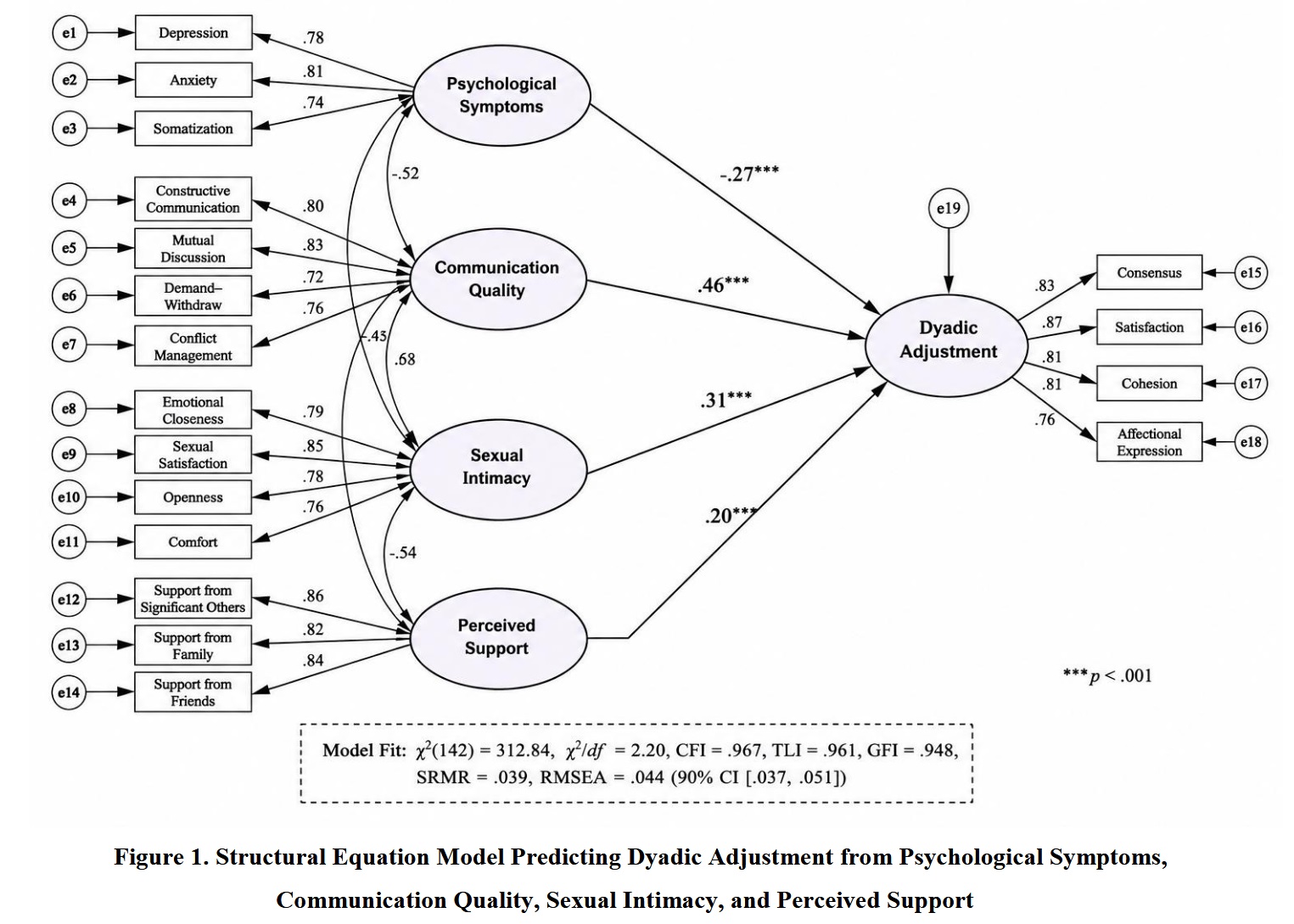
The present study aimed to predict dyadic adjustment among couples using a multimodal framework incorporating psychological symptoms, communication quality, sexual intimacy, and perceived support. This cross-sectional predictive study was conducted among 624 individuals representing 312 couples residing in Mexico. Participants were recruited through community organizations, healthcare settings, counseling centers, and online platforms. Data were collected using the Dyadic Adjustment Scale (DAS), Brief Symptom Inventory-18 (BSI-18), Communication Patterns Questionnaire–Short Form (CPQ-SF), Personal Assessment of Intimacy in Relationships Scale (PAIR), and the Multidimensional Scale of Perceived Social Support (MSPSS). Descriptive statistics, Pearson correlation analyses, hierarchical multiple regression, and structural equation modeling (SEM) were performed using SPSS 29 and AMOS 29. Model fit was evaluated using χ²/df, CFI, TLI, GFI, SRMR, and RMSEA indices. Correlation analyses indicated that dyadic adjustment was negatively associated with psychological symptoms (r = -.58, p < .001) and positively associated with communication quality (r = .74, p < .001), sexual intimacy (r = .68, p < .001), and perceived support (r = .61, p < .001). Hierarchical multiple regression analysis revealed that psychological symptoms (β = -.24, p < .001), communication quality (β = .43, p < .001), sexual intimacy (β = .29, p < .001), and perceived support (β = .18, p < .001) significantly predicted dyadic adjustment, collectively explaining 70.9% of the variance (R² = .709, p < .001). Structural equation modeling demonstrated excellent model fit (χ²/df = 2.20, CFI = .967, TLI = .961, GFI = .948, SRMR = .039, RMSEA = .044). Standardized path coefficients confirmed significant direct effects of psychological symptoms (β = -.27, p < .001), communication quality (β = .46, p < .001), sexual intimacy (β = .31, p < .001), and perceived support (β = .20, p < .001) on dyadic adjustment. The final model explained 73.4% of the variance in dyadic adjustment. The findings demonstrate that dyadic adjustment is a multidimensional relational outcome shaped by psychological, communicative, sexual, and social factors. Communication quality emerged as the strongest predictor of relationship functioning, followed by sexual intimacy, psychological symptoms, and perceived support. These results support systemic and dyadic perspectives of relationship functioning and suggest that interventions targeting communication skills, emotional well-being, intimacy enhancement, and support mobilization may substantially improve couple adjustment and relational resilience.
Downloads
References
Acquati, C., Wittmann, D., Roth, M., Rosen, A., Carr, L. C., Gresham, Z., & Ionescu, E. (2023). Sexual Health Outcomes of Adolescent and Young Adult Colorectal Cancer Survivors and Their Partners: Protocol of a Dyadic Mixed Methods Study. Jmir Research Protocols, 12, e41831. https://doi.org/10.2196/41831
Amiri, S. E., Rosen, N. O., Brassard, A., Rossi, M. A., Bergeron, S., & Péloquin, K. (2023). Dyadic Coping and Sexual Well‐being in Couples Seeking Assisted Reproductive Technology. Family Relations, 72(5), 3134-3151. https://doi.org/10.1111/fare.12874
Arends, S. A., Rossum, C. E. v., Eeltink, C., Robertus, J. E., Schoonmade, L., Francke, A. L., & Jongerden, I. P. (2024). Feasibility and Effectiveness of Communication Tools for Addressing Intimacy and Sexuality in Patients With Cancer: A Systematic Review. Supportive Care in Cancer, 32(2). https://doi.org/10.1007/s00520-024-08308-6
Arthur, E., Bissram, J., Rechenberg, K., Wills, A., Campanelli, K., Menon, U., & Nolan, T. S. (2022). Sexual Health and Intimacy After Cancer Treatment in Women of Color: A Systematic Review. Psycho-Oncology, 31(10), 1637-1650. https://doi.org/10.1002/pon.6005
Azimi, S., Javadivala, Z., Izadi, M. S., Ghilani, N., & Allahverdipour, H. (2025). Communication Skills and Their Socio-Sexual Predictors After Husbands’ Retirement: Gender Differences. Sage Open, 15(3). https://doi.org/10.1177/21582440251357056
Banerjee, D., Mukhopadhyay, S., Tandon, A., & Rao, T. S. (2021). Uncertainty, Sex and Sexuality During the Pandemic: Impact on Psychosocial Resilience. https://doi.org/10.5772/intechopen.98231
Beer, N. (2026). An Exploration of Sexual and Relational Impacts of Vaginal Mesh Injury: A Systematic Review Using Thematic Synthesis. https://doi.org/10.21203/rs.3.rs-8918556/v2
Bennett‐Brown, M., Adams, O. R., Campbell, J. T., Moscovici, Z., & Gesselman, A. N. (2022). Chronic Vulvovaginal Pain in Patients of Color: Benefits of Partner Supportiveness in Relation to Sexual Dissatisfaction and Distress. International journal of environmental research and public health, 19(7), 3975. https://doi.org/10.3390/ijerph19073975
Bertschi, I., Meier, F., & Bodenmann, G. (2021). Disability as an Interpersonal Experience: A Systematic Review on Dyadic Challenges and Dyadic Coping When One Partner Has a Chronic Physical or Sensory Impairment. Frontiers in psychology, 12. https://doi.org/10.3389/fpsyg.2021.624609
Budd, M. A., Gater, D. R., & Channell, I. (2022). Psychosocial Consequences of Spinal Cord Injury: A Narrative Review. Journal of Personalized Medicine, 12(7), 1178. https://doi.org/10.3390/jpm12071178
Cannon, C. J., & Gray, M. J. (2024). A Caregiver Perspective for Partners of PTSD Survivors: Understanding the Experiences of Partners. Behavioral Sciences, 14(8), 644. https://doi.org/10.3390/bs14080644
Castro, R., Araújo, S., Marques, A., Ferreira, D., Rocha, H., Aguiar, S., Pieramico, S., Quinta-Gomes, A. L., Tavares, I. M., Carvalho, J., & Nobre, P. (2024). Mapping the Contributions of Dyadic Approaches to Couples’ Psychosocial Adaptation to Prostate Cancer: A Scoping Review. https://doi.org/10.31234/osf.io/ef6nd
Coyne, E., Dieperink, K. B., Voltelen, B., Barreto, M. d. S., & García‐Vivar, C. (2024). Posttreatment Health Interventions for Adult Cancer Survivors and Their Families: An Integrated Review. Supportive Care in Cancer, 32(11). https://doi.org/10.1007/s00520-024-08909-1
Engström, A. H., Alvariza, A., Kuylenstierna, A., Wikman, A., & Ljungman, L. (2025). Navigating the Hardship Together: Factors Associated With Couple Relationship Functioning in Parents With Cancer Who Have Dependent Children. Psycho-Oncology, 34(8). https://doi.org/10.1002/pon.70245
Estlein, R., Gewirtz‐Meydan, A., & Opuda, E. (2022). Love in the Time of COVID‐19: A Systematic Mapping Review of Empirical Research on Romantic Relationships One Year Into the COVID‐19 Pandemic. Family Process, 61(3), 1208-1228. https://doi.org/10.1111/famp.12775
Gagné, A. L., Brassard, A., Bécotte, K., Lessard, I., Lafontaine, M. F., & Péloquin, K. (2021). Associations Between Romantic Attachment and Sexual Satisfaction Through Intimacy and Couple Support Among Pregnant Couples. European Review of Applied Psychology, 71(3), 100622. https://doi.org/10.1016/j.erap.2020.100622
Gil, M., Kim, S. S., Kim, D., Han, H., Lim, B., & Gagné, J. C. D. (2023). Couple-Oriented Interventions for Mental Health: A Scoping Review. Journal of Family Nursing, 31(3), 159-181. https://doi.org/10.1177/10748407231198249
Hasson‐Ohayon, I., Goldzweig, G., Braun, M., & Hagedoorn, M. (2022). Beyond “Being Open About It”: A Systematic Review on Cancer Related Communication Within Couples. Clinical psychology review, 96, 102176. https://doi.org/10.1016/j.cpr.2022.102176
Jain, C. K., & Khan, W. (2025). Psychosocial Concomitants of Infertility: A Narrative Review. Cureus. https://doi.org/10.7759/cureus.80250
Lampis, J., Simone, S. D., Lasio, D., & Serri, F. (2023). The Role of Family Support and Dyadic Adjustment on the Psychological Well-Being of Transgender Individuals: An Exploratory Study. Sexuality Research and Social Policy, 20(4), 1328-1344. https://doi.org/10.1007/s13178-023-00817-z
Liberacka-Dwojak, M., Wiłkość-Dębczyńska, M., & Ziółkowski, S. (2023). A Pilot Study of Psychosexual Functioning and Communication in Women Treated for Advanced Stages of Cervical Cancer After the Diagnosis. Sexuality Research and Social Policy, 20(3), 1258-1266. https://doi.org/10.1007/s13178-023-00796-1
Malina, A., & Suwalska-Barancewicz, D. (2021). Comparison of Early-Stage Mothers and Childless Women Seeking Pregnancy: Experienced Stress, Resilience and Satisfaction With Relationship With the Partner. International journal of environmental research and public health, 18(5), 2543. https://doi.org/10.3390/ijerph18052543
Navaneetham, P., & Kanth, D. B. (2022). Effects of Personal Relationships on Physical and Mental Health Among Young Adults- A Scoping Review. The Open Psychology Journal, 15(1). https://doi.org/10.2174/18743501-v15-e2208180
Ni Putu Wulan Purnama, S., & Manungkalit, M. (2023). Predictors of Sexual Satisfaction After Cancer in Women. Malahayati Nursing Journal, 5(10), 3630-3644. https://doi.org/10.33024/mnj.v5i10.11979
Otto, A. K., Ketcher, D., Reblin, M., & Terrill, A. L. (2022). Positive Psychology Approaches to Interventions for Cancer Dyads: A Scoping Review. International journal of environmental research and public health, 19(20), 13561. https://doi.org/10.3390/ijerph192013561
Özen, Ş., Karataş, T., & Polat, Ü. (2021). Perceived Social Support, Mental Health, and Marital Satisfaction in Multiple Sclerosis Patients. Perspectives in psychiatric care, 57(4), 1862-1875. https://doi.org/10.1111/ppc.12760
Pereira, M. G., Ribeiro, I., Ferreira, H., Osório, F., Nogueira‐Silva, C., & Almeida, A. C. (2021). Psychological Morbidity in Endometriosis: A Couple’s Study. International journal of environmental research and public health, 18(20), 10598. https://doi.org/10.3390/ijerph182010598
Rosa, V. L. L., & Commodari, E. (2025). Psychosocial Resources and Emotional Support Needs in Women With Vulvodynia: A Lifespan Developmental and Biopsychosocial Perspective. Behavioral Sciences, 15(12), 1600. https://doi.org/10.3390/bs15121600
Santamaría‐Gutiez, R., Martínez‐Corredor, S., González‐Sala, F., & Lacomba‐Trejo, L. (2025). Relevance of Positive Dyadic Coping for Couples Undergoing Assisted Reproduction Treatments: A Systematic Review. Journal of marital and family therapy, 51(2). https://doi.org/10.1111/jmft.70016
Sharma, D., & Sharma, B. R. (2025). Aging, Sexuality, and Intimacy. Can Yoga Help? Journal of Psychosexual Health, 7(2), 98-106. https://doi.org/10.1177/26318318251334733
Stańska, A., Krajewska, M., Mikołajczyk, A., Borzyszkowska, A., Żegleń, S., Karolak, W., & Wojarski, J. (2026). Life Satisfaction and Psychosocial Adjustment in Lung Transplant Recipients: Work, Family, and Sexual Life. Clinical Transplantation, 40(1). https://doi.org/10.1111/ctr.70434
Tavares, I. M., Fernandes, J., Moura, C. V., Nobre, P., & Carrito, M. L. (2021). Adapting to Uncertainty: A Mixed-Method Study on the Effects of the COVID-19 Pandemic on Expectant and Postpartum Women and Men. Frontiers in psychology, 12. https://doi.org/10.3389/fpsyg.2021.688340
Valente, M., Chirico, I., Girotti, C., Ottoboni, G., & Chattat, R. (2022). The Role of the Quality of Relationship in Couples Facing Treatment for Breast Cancer. American Journal of Clinical Oncology, 46(1), 36-42. https://doi.org/10.1097/coc.0000000000000962

Downloads
Published
Submitted
Revised
Accepted
Issue
Section
License
Copyright (c) 2026 Estefania Villarreal-Garza , Airton Knaul (Author); Maria Cecilia González

This work is licensed under a Creative Commons Attribution-NonCommercial 4.0 International License.