The Effectiveness of Solution-Focused Couple Therapy on Hope, Dyadic Coping, and Relationship Resilience among Couples Facing Economic Stress
Keywords:
Solution-Focused Couple Therapy, Hope, Dyadic Coping, Relationship Resilience, Economic Stress, Couples, Marital Relationships, Family Therapy, Strengths-Based Intervention, Psychological AdaptationAbstract
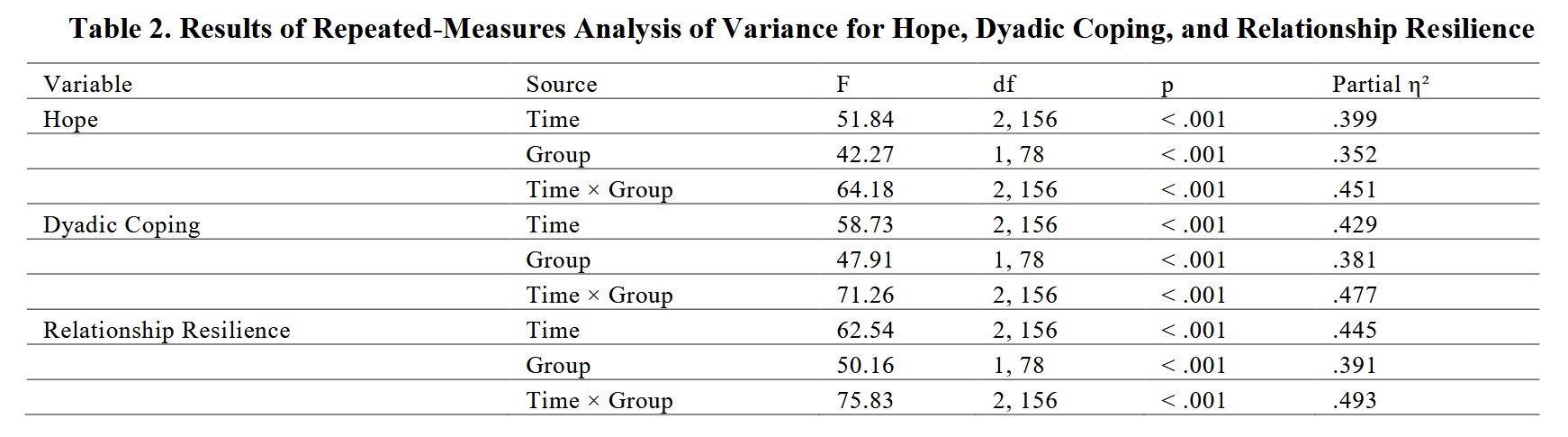
The present study aimed to investigate the effectiveness of Solution-Focused Couple Therapy (SFCT) on hope, dyadic coping, and relationship resilience among couples experiencing economic stress. This study employed a quasi-experimental design with pretest, posttest, and two-month follow-up assessments using a control group. The statistical population consisted of married couples experiencing significant economic stress in Toronto, Canada. Forty couples (80 individuals) meeting the inclusion criteria were selected through purposive sampling and randomly assigned to an experimental group (20 couples) and a control group (20 couples). The experimental group participated in eight weekly 90-minute sessions of Solution-Focused Couple Therapy, while the control group received no intervention during the study period. Data were collected using the Adult Hope Scale, the Dyadic Coping Inventory, and the Relationship Resilience Assessment Scale. Data analysis was conducted using repeated-measures analysis of variance and Bonferroni post hoc tests in SPSS version 29. The results of repeated-measures analysis of variance revealed significant effects of time, group, and Time × Group interaction for all dependent variables. For hope, significant effects were observed for time (F = 51.84, p < .001), group (F = 42.27, p < .001), and Time × Group interaction (F = 64.18, p < .001, η² = .451). Dyadic coping also demonstrated significant time (F = 58.73, p < .001), group (F = 47.91, p < .001), and interaction effects (F = 71.26, p < .001, η² = .477). Similarly, relationship resilience showed significant effects for time (F = 62.54, p < .001), group (F = 50.16, p < .001), and Time × Group interaction (F = 75.83, p < .001, η² = .493). Bonferroni comparisons indicated significant improvements from pretest to posttest and from pretest to follow-up for all variables (p < .001), while no significant differences were found between posttest and follow-up assessments (p > .05), indicating maintenance of treatment gains over time. The findings demonstrate that Solution-Focused Couple Therapy is an effective intervention for enhancing hope, dyadic coping, and relationship resilience among couples facing economic stress. By emphasizing strengths, future-oriented goals, and collaborative problem-solving, the intervention enabled couples to develop adaptive psychological and relational resources that persisted beyond the treatment period. These results support the application of solution-focused approaches as an evidence-based strategy for promoting relational well-being and resilience among couples confronted with financial adversity.
Downloads
References
Allen, K. R., & Goldberg, A. E. (2021). Apart, but Still Together: Separated Parents Living in Limbo During COVID‐19. Journal of marital and family therapy, 48(3), 845-860. https://doi.org/10.1111/jmft.12556
Arıcı‐Şahin, F., & Köse, Ö. (2025). Navigating Couple and Larger Systems Dynamics: Healthcare Workers’ COVID‐19 Experiences in Turkey. Family Relations. https://doi.org/10.1111/fare.70045
Aydoğan, D., Kara, E., & Kalkan, E. (2021). Understanding Relational Resilience of Married Adults in Quarantine Days. Current Psychology, 41(11), 8249-8259. https://doi.org/10.1007/s12144-021-02224-2
Beni, Z. H. M., Alizadeh, A. M., Gazerani, A., Moghaddam, S., & Nikpeyma, N. (2023). Strategies Against Domestic Violence and Its Consequences Amongst Iranian Women: A Review Study. Journal of Multidisciplinary Care, 12(1), 46-55. https://doi.org/10.34172/jmdc.77
Cavour-Więcławek, N., Różańska, A., & Rogowska, A. M. (2025). Assessing the Effectiveness of a Solution-Focused Brief Therapy-Based Intervention on Exam Anxiety in First-Year Polish University Students: A Pilot Study With a Randomized Controlled Trial. Healthcare, 13(16), 2001. https://doi.org/10.3390/healthcare13162001
Cox, M., Norris, D., Cramm, H., Richmond, R., & Andérson, G. S. (2022). Public Safety Personnel Family Resilience: A Narrative Review. International journal of environmental research and public health, 19(9), 5224. https://doi.org/10.3390/ijerph19095224
Cumming, J., Quinton, M. L., Tidmarsh, G., & Reynard, S. (2024). Mental Skills Training for Youth Experiencing Multiple Disadvantage. Youth, 4(4), 1591-1609. https://doi.org/10.3390/youth4040102
Ding, X., Franklin, C., & Kim, J. S. (2025). Solution-Focused Crisis Intervention With Youth and Families. 137-153. https://doi.org/10.1037/0000447-008
Duan, W., Klibert, J., Schotanus-Dijkstra, M., Llorens, S., Heuvel, M. v. d., Mayer, C. H., Tomasulo, D., Liao, Y., & Zyl, L. E. v. (2022). Editorial: Positive Psychological Interventions: How, When and Why They Work: Beyond WEIRD Contexts. Frontiers in psychology, 13. https://doi.org/10.3389/fpsyg.2022.1021539
Franklin, C., Sucher, K., & Kim, J. S. (2025). Solution-Focused Brief Therapy Core Elements and the Process of Change. 23-49. https://doi.org/10.1037/0000447-002
Fu, L., Mao, M., Hong, C. S., Zhang, Y., Chen, C., Yang, Z.-J., Lin, Y., Xiao, H., & Huang, H. (2025). Solution-Focused Brief Therapy Combined With Mindfulness-Based Stress Reduction to Alleviate Claustrophobia During MR Imaging. Medicine, 104(28), e43190. https://doi.org/10.1097/md.0000000000043190
Gagat‐Matuła, A. (2022). Resilience and Coping With Stress and Marital Satisfaction of the Parents of Children With ASD During the COVID-19 Pandemic. International journal of environmental research and public health, 19(19), 12372. https://doi.org/10.3390/ijerph191912372
Gu, J., Wang, H., Pei, J., Meng, J., & Song, Y. (2023). The Dyadic Coping Experience of ICU Transfer Patients and Their Spouses: A Qualitative Study. Nursing in Critical Care, 29(4), 672-681. https://doi.org/10.1111/nicc.12993
Hasanzadeh, M., Samavati, M., & Javaheri, A. (2024). Effectiveness of Couples Coping Enhancement Training on Resilience and Marital Conflict During the Transition to Parenthood. Aftj, 5(2), 46-54. https://doi.org/10.61838/kman.aftj.5.2.6
Hassan-Abbas, N. (2022). Resilience and Risk Factors Predict Family Stress Among Married Palestinians in Israel During the COVID-19 Pandemic. Frontiers in psychology, 13. https://doi.org/10.3389/fpsyg.2022.913330
Höltge, J., Theron, L., Jefferies, P., & Ungar, M. (2021). Family Resilience in a Resource‐Cursed Community Dependent on the Oil and Gas Industry. Family Process, 60(4), 1453-1469. https://doi.org/10.1111/famp.12641
Joubert, J., & Guse, T. (2021). Implementing Solution‐focused Brief Therapy to Facilitate Hope and Subjective Well‐being Among South African Trauma Survivors: A Case Study. Counselling and Psychotherapy Research, 22(1), 147-156. https://doi.org/10.1002/capr.12416
Kaygas, Y., & Özbay, Y. (2023). Do Conflicts Strengthen My Relationship?’ the Role of Relational Resilience on Conflict Frequency and Relationship Satisfaction From the Viewpoint of Turkish Women. Türk Psikolojik Danışma Ve Rehberlik Dergisi, 13(69), 202-215. https://doi.org/10.17066/tpdrd.1214995yy
Kong, Y., Zhang, Y., Sun, P., Zhang, J., Lu, Y., Li, J., & Zheng, Y. (2024). Interdisciplinary Cooperation With Solution-Focused Brief Therapy to Reduce Job Stress, Burnout, and Coping in Chinese Nurses: A Randomised Controlled Trial. Heliyon, 10(22), e40138. https://doi.org/10.1016/j.heliyon.2024.e40138
Liu, M., Yan, Z., & Wu, C. (2025). Comparative Efficacy and Acceptability of Resilience-Focused Interventions for Nurses: A Systematic Review and Network Meta-Analysis of Randomized Controlled Trials. BMC Nursing, 24(1). https://doi.org/10.1186/s12912-025-03090-0
Misca, G., & Walker, J. (2025). Strengthening Military Families: Evaluating the Impact of Relationship Counseling On UK Naval Families. Family Court Review. https://doi.org/10.1111/fcre.70018
Mohamad, Z. S., Bakar, K. A. A., ucsiuniversity.edu.my, A. M. K., Sallehudin, F. U., & May, W. G. C. (2022). The Positive State and Positive Mindset in Building a Positive Relationship: A Review Paper. Malaysian Journal of Social Sciences and Humanities (MJSSH), 7(7), e001640. https://doi.org/10.47405/mjssh.v7i7.1640
Montoro‐Rodríguez, J., Hayslip, B., Ramsey, J., & Jooste, J. L. (2021). The Utility of Solution-Oriented Strategies to Support Grandparents Raising Grandchildren. Journal of Aging and Health, 33(9), 647-660. https://doi.org/10.1177/08982643211004817
Muhammad, S., Ximei, K., Haq, Z. U., Ali, I., & Beutell, N. J. (2021). COVID-19 Pandemic, a Blessing or a Curse for Sales? A Study of Women Entrepreneurs From Khyber Pakhtunkhwa Community. Journal of Enterprising Communities People and Places in the Global Economy, 16(6), 967-987. https://doi.org/10.1108/jec-05-2021-0060
Naseh, M., Badiezadeh, S., Rafieifar, M., Taridashti, S., Reddy, S. M., & Panisch, L. S. (2024). Solution‐Focused Brief Therapy for Improving Couple Dyadic Relationships in Iran: A Systematic Review. Journal of marital and family therapy, 51(1). https://doi.org/10.1111/jmft.12758
Ndze, Y. E., Wiysahnyuy, F. L., & Fokum, D. S. M. (2023). Enhancing Resilience Among Adolescent Students in the University of Bamenda Through Solution-Focused Brief Therapy. The American Journal of Interdisciplinary Innovations and Research, 5(7), 48-56. https://doi.org/10.37547/tajiir/volume05issue07-10
Parker, M. L., & Mosley, M. A. (2021). Therapy Outcomes for Neurodiverse Couples: Exploring a Solution‐focused Approach. Journal of marital and family therapy, 47(4), 962-981. https://doi.org/10.1111/jmft.12526
Periyasamy, C., Narayanan, G., & Ezhumalai, S. (2025). Group Intervention for Intimate Partner Violence Among Female Spouses of Men With Alcohol Dependence Syndrome: An Open-Label, Single-Group Study. Indian Journal of Psychiatry, 67(3), 340-345. https://doi.org/10.4103/indianjpsychiatry.indianjpsychiatry_641_24
Priastuty, B. A. D., Aulia, S. Z. N., Afifatunnisa, A., & Kaloeti, D. V. S. (2023). Long-Distance, Strong Connection: Shaping Family Resilience in the Face of Long-Distance Marriage. Proc. Int. Conf. Of Psy. Stu., 4, 105-116. https://doi.org/10.58959/icpsyche.v4i1.29
Tadros, E., Fahmy, C., Jordan, S. S., & Guajardo, A. (2023). Self-Efficacy, Goal Orientation, and Relationship Ideologies Among Incarcerated Men and Their Romantic Partners. Crime & Delinquency, 71(5), 1514-1534. https://doi.org/10.1177/00111287231194716
Wang, C., Shen, L., Shields, J., Huang, Q., Wu, Y., Yin, J.-W., & Zhao, J. L. (2024). The Efficacy of an SFBT-Based Positive Psychology Intervention in Promoting University Students’ Post-Traumatic Growth and Psychological Resilience After the COVID-19 Pandemic: A Quasi-Experiment. Research on Social Work Practice, 35(5), 487-496. https://doi.org/10.1177/10497315241229667
Zhang, N., Zheng, T., Liu, X., Yu, X., & Wang, L. (2023). Burden, Coping and Resilience Among Caregivers for Patients With Chronic Obstructive Pulmonary Disease: An Integrative Review. Journal of clinical nursing, 33(4), 1346-1361. https://doi.org/10.1111/jocn.16954
Zhang, T., Yan, P., Huang, Z., Li, L., Zhou, Y., Xiao, Y., Ma, G., Liu, Z., Xu, J., & Gu, C. (2024). Interrelation Between Dyadic Coping and Psychological Resilience Among Cervical Cancer Couples in Northwest China: An Actor-Partner Interdependence Model. Asia-Pacific Journal of Oncology Nursing, 11(12), 100615. https://doi.org/10.1016/j.apjon.2024.100615
Zídek, T. M. (2023). Solution-Focused Therapeutic Methods. E-Psychologie, 17(2), 41-57. https://doi.org/10.29364/epsy.468

Downloads
Published
Submitted
Revised
Accepted
Issue
Section
License
Copyright (c) 2026 Kamal Darabi ; Justin Yeh (Author)

This work is licensed under a Creative Commons Attribution-NonCommercial 4.0 International License.